Greetings Ija.
Greetings Ajakait. How are you today?
I am doing good Ija. Today, I am answering the daily writing prompt:
“You have three magic genie wishes, what are you asking for.”
You see Ija, I am reflecting on the campaign messaging, especially of the National Unity Platform (NUP) Presidential Candidate. In particular, Candidate Kyagulanyi’s message yesterday, 27th October 2025, to the people of Lango.
What about it Ajakait?
Ija, you are going to think me funny, but, in order to explain why I am mulling over Candidate Kyagulanyi’s message, let me first read for you what a presidential candidate decades ago told the people of Lango during a huge rally:
“You wake up very early and go to the garden. You stay in the sun the whole day producing maize. You take the maize to the market they give you 200 shillings per kilo … We must invest where our people are. A strong farmer must become strong and prosperous again as a farmer.” Forum for Democracy (FDC) Presidential Candidate, Retired Colonel Dr. Kiiza Besigye.
Ija, if you want to watch and listen to all of it, there is a video clip of that Candidate Besigye rally that was captured by NTV and it is doing the rounds on social media.
I will look for it after, Ajakait go ahead.
Ija, if presidential and parliamentary elections were about issues, what Candidate Besigye spoke about decades ago, would be the major issue during the ongoing campaigns for the 2026 election.
That is why in answer to today’s prompt, I would be asking for there to be a presidential candidate whose campaign is focused and gets elected on a reform agenda centered on three things:
- Genuine rural development for Uganda.
- Elevating the position of smallholder farmers, so as to ensure they are food secure, prosperous and strong as farmers – retaining and farming their land.
- President Museveni in retirement as our venerated past leader
For context to my last ask, “click here to re-read my “Letter to President Museveni.”
Ajakait, why the three asks and what does this have to do with Candidate Kyagulanyi?
Ija, the majority of households in Uganda, 62.3% of them, derive our livelihoods from agriculture. Smallholder farming. This is according to the most recent Uganda National Household Survey (UNHS) 2024.
It makes sense for messaging from campaigning candidates, for example, to address issues, such as farm-gate prices; farmers’ access to favorable capital; combating negative effects of climate change; significantly reducing agricultural waste, especially food waste, through better post-harvest handling and storage.
But, decades later, since Candidate Besigye spoke of it, the grim situation for the majority of Ugandans, smallholder farmers, remains astonishingly the same; or likely worse, ija.
Ajakait, was Candidate Kyagulanyi, also speaking about the situation of farmers during his rallies in Lango? Please get to the point my dear.
No, Ija. From what I have heard, his central messaging in Lango focused on demonstrating the importance of the people of Lango uniting with the people of Buganda, in particular, and with the rest of Uganda, in order to rid Uganda of President Museveni.
What are you on about Ajakait?
Yes, Ija, Candidate Kyagulanyi’s central messaging was: “People of Buganda have been having problems. People of Lango have been having problems. We need to unite to get rid of President Museveni. A protest vote,” something like that.
Basically, Ija, what I understood from the messaging is that Candidate Kyagulanyi accuses President Museveni of divisiveness along ethnic lines. The basis on which he is urging us to protest vote out President Museveni and vote Candidate Kyangulanyi in.
Ebe, Ija, we should forget the past and work towards a united future. Something like that.
Ajakait, I am waiting to understand why you are relating Candidate Kyagulanyi’s messaging to that of Candidate Besigye.
Ija, please be patient and hear me out.
Ija, using the situation of household food security as a proxy for poverty, I fact checked Candidate Kyagulanyi’s insinuation that we are similarly burdened.
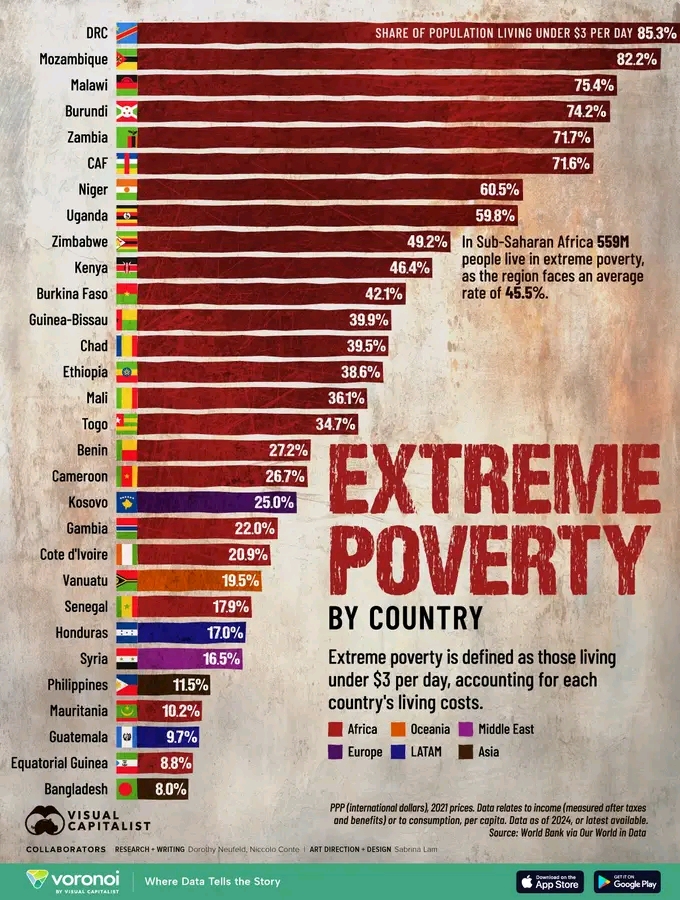
As a nation state, Ija, overall, Candidate Kyagulanyi is on point. A whopping 52% of Ugandan households are food insecure. This finding of the UNHS 2024, moreover, is supported by World Bank data, as it was shared in an info-graphic by Visual Capitalists. Let me WhatsApp you the info-graphic Ija:
Ija, have you seen it?
Yes, Ajakait, a terrible state of affairs. Our country, Uganda, is among the top countries with large proportions of populations experiencing extreme poverty.
Yes, Ija. As of 2021, according to the info-graphic, 59.8% of Ugandans were living on less than $3 per day. As in, the majority of Ugandans were living, for everything, on about only 10,550 shillings per day!
Ija, no wonder the UNHS 2024 found the majority, 52%, of Ugandan households are food insecure. They experience:
“Frequent and prolonged periods of insufficient food intake due to lack of money and other resources, forcing members of those households to skip meals or go an entire day without a meal.” Uganda Bureau of Statistics (UBOS)
By the way Ija, even today, Gaetano Kaggwa, the media personality who hosts a morning show on 91.3 Capital FM, during the show, shared a testimony of a time he was broke.
According to him, he did not have money to cover all his necessities. To survive, he said he would buy one chapati and cut it into four parts – one he ate for breakfast, another for lunch, another for super and the other one when the hunger pangs became too much.
Ajakait, I am not yet making the connection, what is the connection with all you are saying with the NUP message in Lango?
Ija, my assertion is that Candidate Kyagulanyi was insensitive to the suffering of the people of Lango, by likening their ‘problems’ with those of Buganda.
How so, Ajakait?
You see Ija, a significant proportion of Uganda’s food insecure households are in Lango. Ija, only 36.3% of households in Lango are food secure. The significant majority, 63.7%, of households in Lango are food insecure.
Ija, compare it to the situation in Buganda where a huge majority, 70.7%, of households are food secure and only 29.3% are food insecure.
I am beginning to see your point Ajakait. You are saying …
Yes, Ija, what I am saying is that it is likely that for the majority of people in Lango their priority is emere ya lere (food for today); as in they are living from hand to mouth, so to speak.
In which case, a promise to invest in smallholder farmers and where they are, as propositioned by Candidate Besigye, likely resonates better with the people of Lango.
Ija, the people of Lango, arguably, are at the lower-level of Maslow’s hierarchy of needs; and are likely motivated by messaging that focuses on those lower-level needs – basic needs, such as food to eat to stay alive.
Perhaps, Ija, the people of Buganda, where the huge majority of households are food secure, are the ones more likely to be persuaded with the “protest vote” narrative.
Ija, the situation of the people of Buganda, arguably, allows them to be motivated by the higher-level needs of Maslow’s hierarchy – belonging, esteem, etc.; as in “NUP’s protest vote.”
Okay Ajakait, let us wait and see how the people of Lango vote.
Yes, Ija, let us, but I think the result is already kind of predictable. After all, this time round, after many rounds of campaigning on the “No Change” slogan, the incumbent, Candidate Museveni, is campaigning for re-election on the “Protecting our Gains” slogan.
And, honestly, Ija, I think that all ‘opposition presidential candidates’ are shying away from picking apart the “gains” and demonstrating how they offer a valid and viable alternative.
In fact, as a matter of fact, the ‘opposition presidential candidates’ are mostly also trumpeting similar promises rooted in the injustice of unequal development in favor of urban centers and to the detriment of rural areas. You know the more tarmac roads blah, blah, blah.
Ajakait, thank you for calling and updating. Bye for now.
You are welcome Ija. Bye.






Let’s Chat…