
The Constitutional Court’s decision striking off from Section 115 of Uganda’s Penal Code Act the ‘insulting modesty of a woman’ charge, reminded me of a conversation.
A conversation with two significant Ugandan men, who are often misjudged, falsely accused and exiled for allegedly doing just that, ‘insulting modest of a woman.’
The context of the conversation, to which others and I were listeners, an X-Space, was an endeavor to promote conscious awakening for us all to appreciate that as citizens we are political beings.
The tone of the X-Space was to urge us to recognize and value the social contract we have with the State. Particularly, in the sense that “anyone depending on our taxes should expect critique from us the tax payers.”
Importantly, also, for us all to take seriously our duty to recognize the difference between rational legislation and irrational legislation.
Context
It is shocking that an irrational, likely racist and Anglo-Saxon centric colonial charge, enacted in 1950, during the British-Colonial era, sustained on the Penal Code decades later.
Scandalous it is that in this, the 21st Century, said legislation was used by two advocates to file a suit against the President of the Uganda Law Society (ULS), Isaac Ssemakade.
 Advocate Isaac Ssemakadde, President of Uganda Law Society, and the host of the X-Space referred to herein.
A suit that led to the questionable ‘legal persecution’ of Ssemakade, culminating to him fleeing into exile.
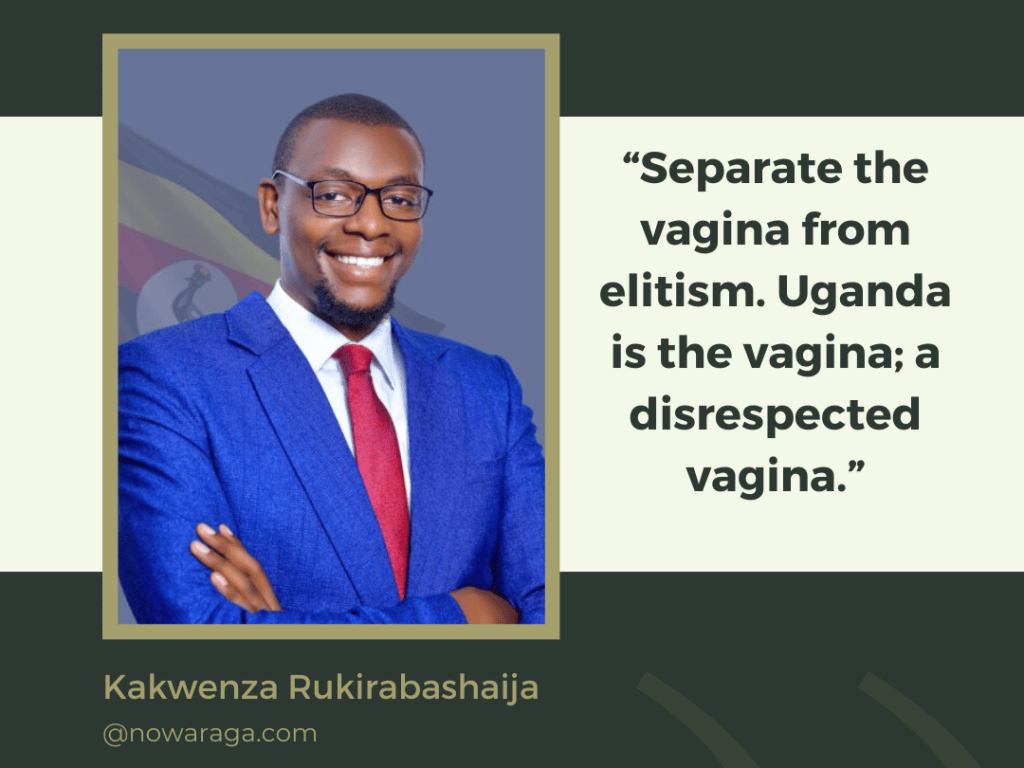
Exiled award-winning writer and human rights lawyer, Kakwenza Rukirabashaija, who was in conversation with and hosted by Ssemakadde, spoke of how denial of rights and torture turned Kakwenza into an angry person.
Adding that it is the reason he, Kakwenza, has no kind words for politicians. Presumably, politicians who gloss over and facilitate implementation of irrational legislation and or who irrationally implement rational legislation.
During the conversation, Kakweza gave an example of how the Office of the Director of Public Prosecutions (ODDP) “doesn’t do what they are supposed to do.”
Specifically, pointing out how actors in the Uganda Police Force execute “arrests before investigation, instead of investigating before arresting.”
Logical expectation is for ODPP to repudiate this anomaly of the “police to prison pipeline,” as Ssemakadde charactarizes it. It is the duty and mandate of the ODPP to do so.
But, as asserted by both Kakwenza and Ssemakadde, ODDP instead legitimizes the anomaly; allowing seeming illegal arrests to be made and sustained.
Vagina
It is within the context of the conversation that Kakwenza took issue with Ssemakadde’s figurative usage of the vagina, when he described the then ODPP, Justice Jane Francis Abodo, as “vagina from Karamoja.”
A description, which became the basis of the suit brought against Ssemakadde.
Launching from a critique of feminist women elitism, Kakwenza advocated: “separate the vagina from elitism. Uganda is the vagina; a disrespected vagina. Celebrate and value the vagina.”
In Kakwenza’s figurative use of vagina, and according to him, Justice Abodo is not befitting the accolade “vagina from Karamoja.”
Kakwenza holds Justice Abodo accountable as the ODPP who for presided over the ODPP that according to him doesn’t do its job and is de facto disrespecting Uganda, the vagina.
What Next?
Whereas, I celebrate nullification of an archaic charge, I fear that it was done so for the wrong reasons, kind of.
Where was the insult in the first place?
Will the Court’s request for legislative modification for purposes of gender equality perpetuate false affirmation that the vagina is an insult, in itself?
The norm of perceiving the vagina in the negative prevails and permeates significantly in our society.
Negative perception of the vagina can be deduced from Ssemakadde’s figurative usage of vagina. From the tone of the suit brought against him. From the suit challenging the Charge. And Constitutional Court ruling nullifying the charge.
“Eve Ensler in her book The Vagina Monologues (the play by the same title was blocked in Uganda by the Ethics and Integrity ministry) asked several women to describe their vaginas and many sounded like they were talking about dark, dump, haunted attics with broken furniture. It was actually sad to read. After reading her book, I tried the same experiment on a few work colleagues and my findings were not different. None of the women I talked to had ever ‘checked themselves out’ in a mirror and one described her genitalia in such disgusting terms I now hate to print here. You would be forgiven for thinking she was talking about the Kiteezi landfill!” Carolyne Nakazibwe (source “Sex Talk: What if women were like men …” published in The Observer
It is the negative perception of the vagina, as though it were a landfill, for example, that we urgently need to get rid off and to decolonize our minds.
Decolonize our minds to the extent that we rightly encode its functional representation in our figurative usage of the vagina, as does Kakwenza.









Let’s Chat…