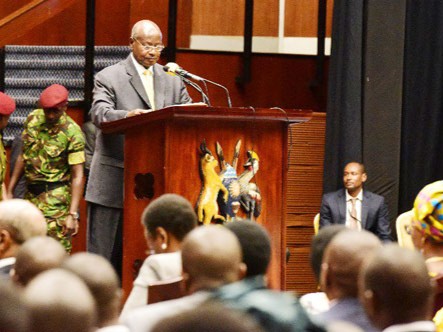
“Uganda is enriching other countries by excessively importing products and services that your own children can produce, if assisted by the State … You donate both wealth and jobs to outsiders … We need to massively end this modern day slavery of undermining our prosperity, while we support the prosperity of other.”
Words of wisdom from His Excellency the President of Uganda, Yoweri Kagutta Museveni, in the State of the Nation Address, 2017, which he delivered on 6th June 2017, at the Uganda International Conference Centre Serena.
He pointed out, in the address, the five issues that are the long time focus of his administration – Peace, Development of Infrastructure and Human Resources, Wealth Creation, Jobs Creation, and Market access.
But then goes on to lament failure to achieve them, blaming it on others junior to him, for whom he has full constitutional power over and mandate, as the President, to bring to order and to book.
Take for instance the aspect of peace. Which I agree with his definition of it being “absence of war and absence of lawlessness.”
While celebrating success in creating absence of war, he acknowledges failure to ensure absence of lawlessness. Among those whom he credits for this failure, are men and women in uniform in the Uganda Police Force.
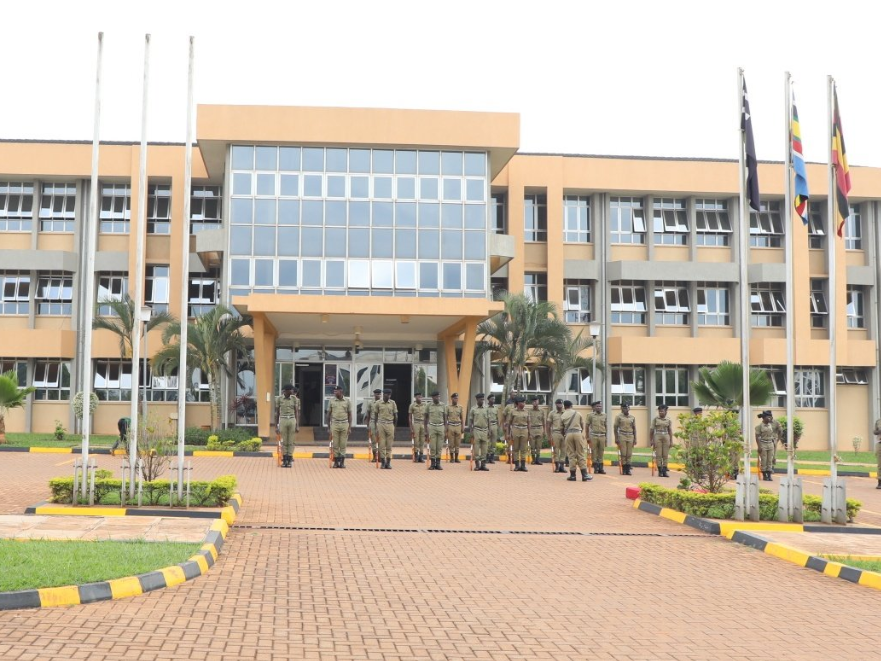
Some in the Police Force are corrupt
Instead of preventing crime, according to the President, “rotten elements” in the Police Force are busy “extorting money from the public” and are the ones instead “protecting criminals or allowing criminals to infiltrate the police.”
And he vowed to “clean up rotten elements” from the Police Force. But then I ask, why hasn’t he and his administration done it already?
Well, one of the excuses that the President gave for failure to cause “absence of lawlessness” is “absence of cameras in towns and the highways.”
Some of us who lived through the genuine human-centered maintenance of law and order, via the Resistance Council System, of the neighborhood watch, we wonder why it was abandoned.
And please, do forgive us if we are not convinced that the solution that will deal with lawlessness is security cameras.
Talking human-centered systems. On the issue of development of human resources, I agree with the President’s interpretation of it too – education and improved health.
I like, particularly the idea of ensuring health via “prevention rather than cure.” De facto the President’s pledge that his administration will continue to focus on delivering services on immunization, nutrition, hygiene, clean water, behavior change, anti malaria, and responsible life style (no obesity, no alcoholism).
Rightly, the President asserted the central role of agriculture in wealth creation.
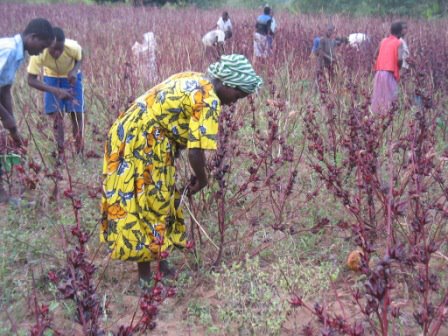 Hibiscus sabdariffa picking at Alinga Farms
No subsistence farmers in Uganda
However, I disagree with the President and his administration’s peddling of a falsehood that “69 percent of our population are subsistence farmers.”
I doubt modern day existence in Uganda of a farmer who produces exclusively and or mostly only for own consumption. The majority of Ugandan farmers current are smallholder farmers who produce mostly for the market.
They produce to sell and then buy to eat.
The false characterization of the majority of Uganda’s wealth creators as “subsistence farmers”, results in the President further asserting a falsehood that Uganda has “a big proportion of people who are not engaged in wealth creation.”
Consequently, a misnomer, characterizing the majority of Uganda’s wealth creators as subsistence farmers, forms the foundation for inappropriate policies for the agriculture sector.
Particularly, the patronizing and dangerous prescription for public misspending huge amounts of resources providing “more and more skills training,” but which skills training is essentially inappropriate.
Production versus Productivity
Inappropriate in the sense that the norm is to focus skills training on production, which I dare say, majority smallholder farmers are already doing well against significant odds.
Appropriate skills training that Uganda’s smallholder farmers need the most, is that which is geared towards increasing productivity:
- Reduce production costs, such that farmers may get increased profit.
- Increase farm gate prices, such that farmers get more profit.
Among the 81 pieces of legislation on the legislative program 2017/2018 the President proposed are two on agriculture that I welcome – “Agriculture extension bill” and “NAADS (National Agriculture Advisory Services) bill.
I welcome these two bills to the extent that their focus enables farmers better function in the trade arena; ensuring the majority of Uganda’s farmers, smallholder farmers, get good and fair terms of trade.
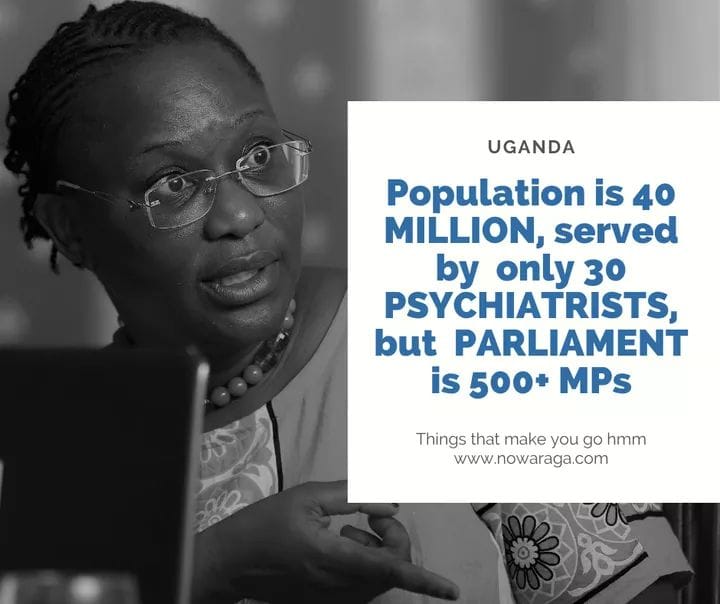
I also welcome the mental health bill. For, in my book, the definition of peace necessarily includes one having peace of mind and being in good mental health.
Truth be told, in 2017, after decades in power, it is not realistic to expect in his state of the nation address something as profoundly new as the things he said way back in the state of the nation addresses of the 1980s and 1990s.
It is, in fact, revealing how the tone of the 2017 state of the nation address is deaf to reality that the President’s comparison baseline can no longer be the state of affairs during previous administrations.
For example, “20.4 percent of the population has access to electricity, up from 4 percent in 986” as he included in the address.
Each state of the nation address during his long stay in power is de facto a self judgement of his performance as a leader and the performance of the political party, the National Resistance Movement, the administration that he leads.
His address, must of necessity explain why 31 years later, only 20.4 percent of the population has access to electricity.
Providing a basis for the conclusion that his decades long leadership seems now experiencing diminishing returns.
And so, I remain among those who long for the day he will be like his peers with whom he was heralded as Africa’s new breed of leaders, who have retired and are living happily in their respective countries.
For him to transition into being our revered past president who continues to guide our nation, guide Africa and guide ‘the world’, while also personally tending to his beloved cattle in Rwakitura.






Let’s Chat…