
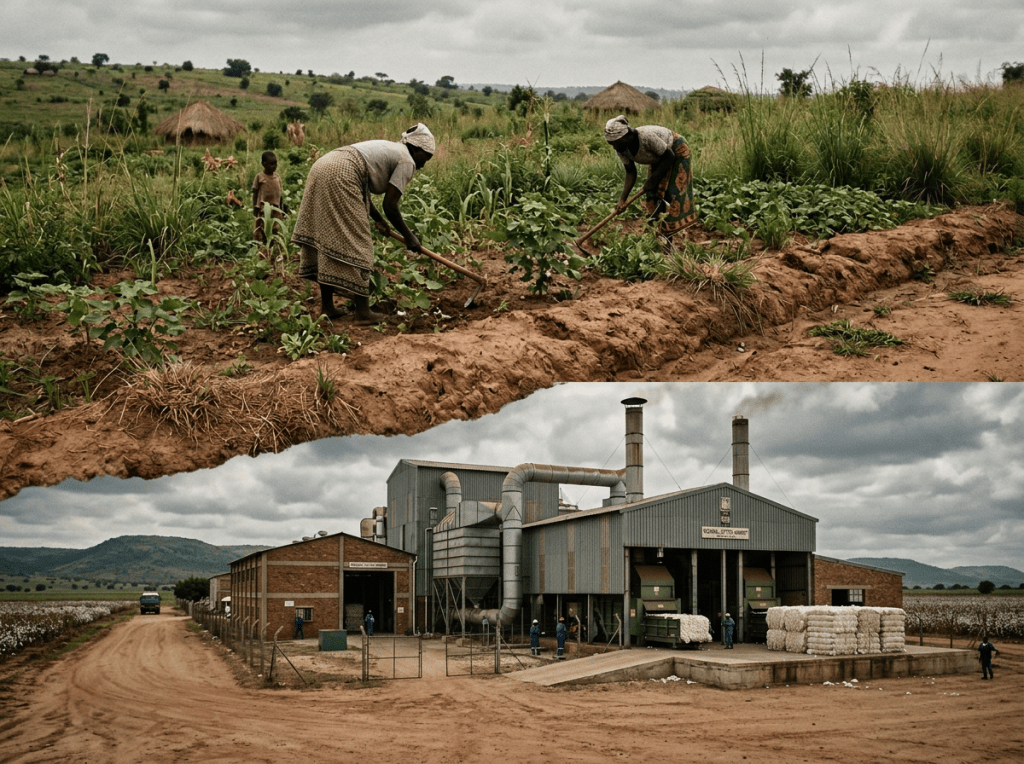
It is no longer cotton. The crops have changed. As did cotton. in the name of ‘progress’ and in the name of ‘modernization’, new crops propagate negative ills, including land grabbing for starters.
Constructive land dispossession is when people are not moved off their land, but are conned into offering their land rent free to grow a particular crop to supply an ‘investor’.
Smallholder farmers become laborers on their own land, while at the same time, they take the burden of the risks of crop failure, due to inappropriate weather, among others.
Constructive land dispossession re-defines land uses intra-homestead. The more powerful members of a homestead, likely men, may easily grab land off other members of a homestead; and re-allocate it to production of a ‘modern crop’.
The Case of Epuripur Sorghum in Teso
Case in point, Teso smallholder farming households were manipulated into diverting their land to grow Epuripur sorghum under the pretext that it was for their own good.
Whereas, the real main objective for promoting Epuripur sorghum is so that Nile Breweries has access to cheap raw materials for brewing beer.
The role of smallholder farmers is to use their land rent free to grow Epuripur sorghum, in order to supply it to Nile Breweries. As in, Nile Breweries does not rent the land.
 “I can say that Epuripur had a 70 percent effect of destabilizing the balance – causing disruption of social systems in Teso. The experience of Epuripur between men and women differs. For the men they are happy because it brought cash; for the women they are not happy for it brought the trouble of not being able to eat it as atap (Expert respondent in empirical study of Agriculture in Uganda (2016).”
One need not be a rocket scientist to deduce that, as was the case of cotton in the 1920s, Iteso women have likely experienced official violence for the “matrimonial offence” of refusing or resisting constructive land dispossession by men re-allocating land to Epuripur sorghum.
 “Colonial government officials, Christian missionaries, and elite cotton-growing African men regarded women as too powerful and independent, threatening their progress agenda. They therefore saw official violence not as traditional or part of a defense of customary law, but as an innovative and progressive way of dealing with women who were central to the farming economy and far too independent for men’s comfort.” This is an extract from Carol Summers’ “Whips and Women: Forcing Change in Eastern Uganda during the 1920s.”
Noticeable similarities exist with the current situation of women in Uganda with the situation of women in Uganda in the 1920s. ‘Progress agendas’ are still defined by government officials (mostly men) and who are culturally dislocated.
It is a fact, official violence against women sustains within public policy and practice, albeit sometimes sub-consciously. Nevertheless, manifesting an irresponsible ‘progress agenda’.








Let’s Chat…