
I am disappointed at how shallow and superficial popular debates on Ugandan culture and gender issues are.
For instance, discussions in reaction to the reported comments that President Museveni made to the effect that he has not cooked since he married his wife, the first lady, Janet Museveni.
 “I haven’t cooked since I married Janet,” President Museveni is quoted as having said.
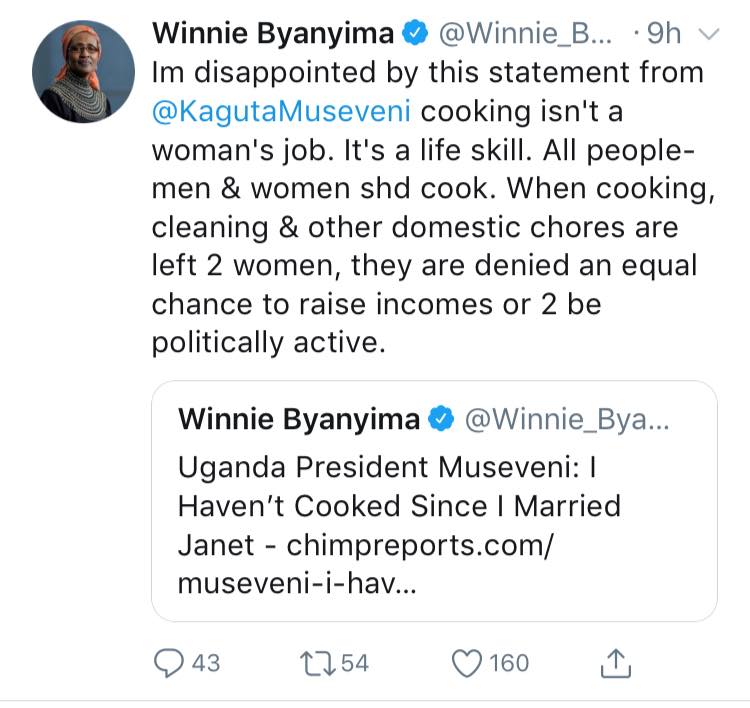
First of all, I have not known President Museveni to have ever expressed an alternative view. This has always been his position.
Wile he holds such views, many have celebrated him as a ‘progressive leader’ who has allegedly done a lot for women.
Secondly, President Museveni’s comment is consistent with what is considered normal within the Ugandan culture-normal criteria, which is that married men do not cook food in the home.
Ugandan cultures constrain married men from cooking in the home.
There are several derogatory ways used in Uganda to describe a man seen cooking food in his home.
Among the largest first nation of Uganda, the Baganda, it is the norm when a woman gets married for variations of the word “okufumba”, which means “to cook”, to be used to describe her new status as a married woman.
Iteso, the fifth largest first nation of Uganda, from whence I am descended, refer to such a man, who cooks in the home, with variations of the word ebwacit, which means either a transvestite or a man dressing and behaving like a woman.
The connotation, according to the culture-normal criteria of the Iteso and of the Baganda, cooking food at home should normally be a role of women.
Meaning, therefore, that according to Ugandan culture, men cooking at home is a taboo – as in the man’s business is definitely not in the kitchen.
The logic that men do not cook at their homes is in fact what predominantly informs how women in their roles as mothers, sisters, aunts, grandmas, wives, daughters, you name it, socialize men in Uganda.
Thirdly, Uganda’s gender-differentiated socialisation processes are consistent with the tendency for predominantly peasant societies to allocate gender roles on the basis of biological attributes.
I consider shallow and superficial the reactions to President Museveni’s comments that I have read. Comments seemingly launch from the culture-normal criteria of global-western centric cultures.
Comments nurturing diversionary debate; the kind which diverts attention from the realities in Uganda.
Castigating President Museveni for his comments diverts attention from the fact that many married professional carrier women and politicians, likely hardly do the cooking in their homes, if at all.
Are we truly expected to believe that Hon. Janet Museveni, who is currently not only the First Lady, but is also the Minister of Education, cooks at home?
 Millet porridge and sukali ndizi (sweet bananas). Millet porridge is among President Museveni’s preferred diet, it is reported.
Not even his favorite bowl of millet porridge do I think his wife now makes for him herself. The reality is that in the homes of wealthy career women and politicians, chefs, including male chefs, do the cooking.
Or at worst, it is often the case that the labor of poor people is being exploited, including that of poor relatives, as maids or houseboys, who do the cooking in the homes of the wealthy.
Laboring for no pay or at very low pay and, moreover, often in shitty working conditions is the plight many children men and women face in Uganda.
 Recommended reading: empirical research findings, published in Chapter 5, “Food Security in Uganda: How Culture Affects Access to Food”, in the book: “Africa Rising – A continent’s future through the eyes of emerging scholars”, edited by Erica Shaw and Hayley Mackinnon and published by the Africa Initiative and The Centre for International Governance Innovation.






Let’s Chat…