How I Met My First Boss
 Stan Burkey, still drops in to visit with me. He is my mentor and fatherly figure of sorts. He is, the author of the book: “People First – A Guide to Self-Reliant Participatory Development.”
We happened to be on the same flight from Brussels to Entebbe. Those days, in 1992, it was called SN Brussels.
Planes to Uganda those days were pretty empty. After all, Uganda had just come out of a protracted civil war.
I had a lot of luggage. I see this old looking muzungu man (white man) and I thought, “I am going to bully that one.” So, I go and sit near him and I toss all my bags in the seats between us.
He was polite to me, chatted me up, asking me who I am and other personal questions. And then he asked me:
“But why are you going back to Uganda?”
I think to myself, “what a question?” But, I answer.
And he asks again:
“But what are you going back to do in Uganda?”
I think to myself, “this man is so tiring.”
Eventually, he asks:
“What did you study at Queen Margaret College?”
I had my stuff in my handbag, so I showed him.
And then he said:
“I might be in position to give you a job.”
And I thought, “okay this is a dirty old man.”
Anyway, we arrived safe, I get off the plane with my luggage and I go home.
About three days later, he drives all the way from Kampala to Entebbe, coming to look for me.
He had pulled an advert advertising for the position of Administrative Assistant with Quaker Service Norway.
Using just our encounter on the plane; how I presented myself; and how I was confident; made him to stop the advert and he hired me as the first Administrative Assistant ever for Quaker Service Norway in Uganda.
And so it was that on my way back from university, after my first degree, I met a man, Stan Burkey, who was to become my first boss.
At Work
But, you can imagine, in 1992, freshly landed back home from university. When I told my father that I had got this job from some muzungu man I had sat next to on the plane. He, of course, commanded:
“I forbid you from taking that job.”
And I thought, “okay, I have a degree, I can think for myself.”
The very next day, after he commanded me not to, I took off from home, went and took up my position and I started work.
Six months later, he promoted me to become Administrative Secretary (Director, really).
I worked alongside him implementing the Change Agent Training Programme, first under Quaker Service Norway and then under the Uganda Change Agent Association.
Years later, when he was retiring, I took over from Stan. I became the Executive Director for Uganda Change Agent Association, an association which came to existence from the work that we did with him, under Quaker Service Norway.
 The day I was recognized as one who has significantly contributed to positively impacting on the lives of thousands of Ugandans and of members of their households. Dr. Maggie Kigozi, in her capacity as the Patron of the Uganda Change Agent Association (UCAA), presented me with the UCAA Award of Merit on behalf of the members of UCAA – thousands of men and women from all over Uganda.
Exposure and Education
No doubt, my formal schooling in United Kingdom was instrumental in determining my career path. It likely made it comparatively easy for me to get a full-time paid job.
Moreover, without necessarily competing for the job in the traditional way – respond to an advert and be interviewed in competition with many.
Formal-schooling-wise, I am as exogenously influenced as a Ugandan can get, hopefully in a good way.
My second degree, Master’s degree, is from The Open University United Kingdom.
And I was fortunate to do my first degree at Queen Margaret College in Edinburgh (now Queen Margaret University), fully sponsored by my father.
For my A-Level, I went through Namasagali College and at the time, Father Grimes, a Englishman, was the headteacher.
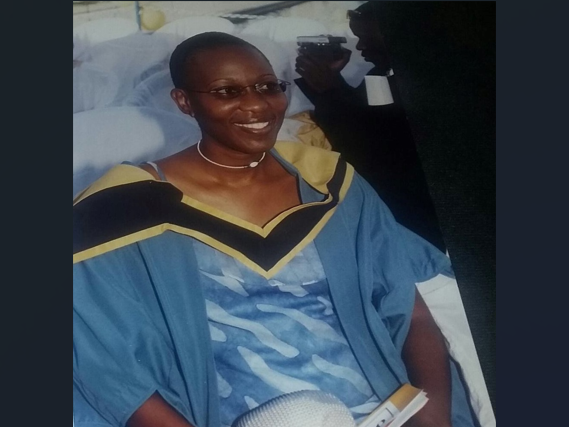 Graduating with Master in Science Degree from the Open University, UK.
Above all, however, I am convinced that the manner in which I was raised and nurtured by my parents, and extended family, played a more significant role in influencing my career path and easily getting a full-time paid job.
I was raised to be rooted and proud of who I am.
I am Alinga Esta Norah Owaraga, Atesot, a Ugandan, an African, and I am culturally rooted. CLICK HERE to read more in “Going back to our roots & be culturally rooted.”






Let’s Chat…