Knowing what my Iteso identity means to me, during this past couple of weeks, award winning novelist and human rights lawyer, Kakweza Rukirabashaija, has tagged me to two of his posts on X, querying and correcting misinformation about the Kumam people of Uganda.
A bit about the Kumam first. According to the most recent Uganda population census of 2024, there are over 350,000 Ugandans who identify as Kumam. Like Iteso, my people, Kumam are part of Atekerin people; classified among Nilotics.
CLICK HERE to read more about the sizes of Uganda’s indigenous communities
There have been many intermarriages among Iteso and Kumam that many often cannot tell the difference. Among prominent Kumam families and whom I consider ‘friend-relatives’, are the family of late papa Ekinu. Papa Ekinu was Kumam and Toto Apolot, his wife, also since rested, was of Iteso.
CLICK HERE to read more about the Ekinu family
Papa Ekinu was the minister who was killed by Uganda People’s Army (UPA) rebels in Teso. At the time he was abducted and killed, he was the Deputy Minister of Ministry of Transport and Communications.
CLICK HERE to read more about his fate as documented by the Monitor in story tilted: “Ministers risk their lives for peace in Teso.”
Back to Kakwenza’s posts on X that have gotten me nostalgic:
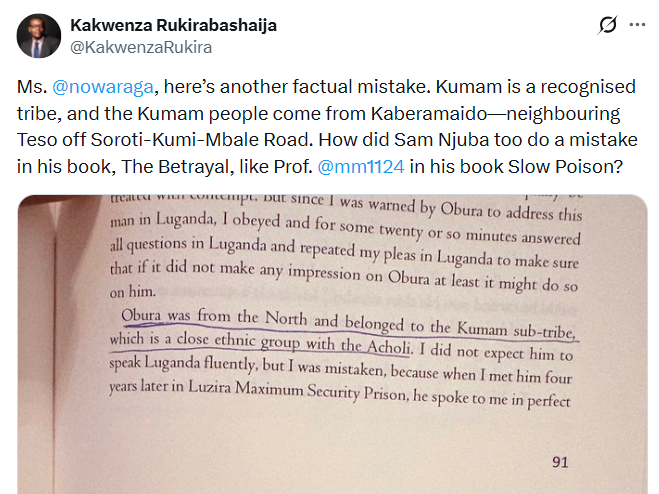
Njuba’s book, “The Betrayal” is rated so highly on Amazon – 4.7/5 rating. This means it is well received and is widely read. I despair to think how many have read the book and have internalized a significant falsehood about Kumam; and about Acholi – “Kumam sub-tribe, which is a close ethnic group with Acholi.”
Acholi are not part of Atekerin as are Kumam; are not part of Nilo-Hamites or Eastern Nilotics as are Kumam. Acholi are among Luo people and are classified Western Nilotic. Kuman are among indigenous communities of Uganda as recognized in the Constitution. An independent nation and not a sub-tribe.
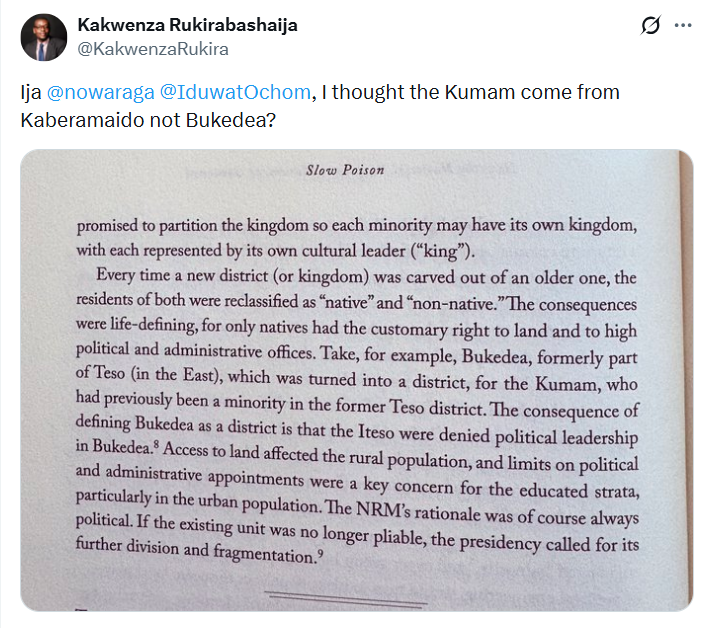
The Kumam have historically claimed their homeland in areas neighboring Lake Kyoga. In terms of districts, Kaberamaido is the one district which they fully claim as their own. Kaberamaido has since been split and Kalaki District curved from it. In addition, there are areas in Soroti and Serere that Kumam consider part of their geography and chiefdom.
Kumam homeland is still considered part of the wider Teso Cultural Region, and therefore, likely still part of the Teso District of the past that Professor Mamdani refers in his book, “Slow Poison.” Bukedea is generally considered part of the Iteso part of Teso. I am unaware of it ever being considered of Kumam.
Iteso, as of the most recent Uganda population census, are the fourth largest first nation of Uganda; with over 3.1 million Ugandans identifying as Iteso. I have difficulty accepting it as fact that “Iteso were denied political leadership in Bukedea,” as published in “Slow Poison.
Bukedea political leadership current is dominated by Iteso, me thinks, and I have my doubts that Iteso were ever denied political leadership in Bukedea. I a more inclined to belief this is a big error in the book “Slow Poison” and Mamdani meant Kaberamaido and not Bukedea.
This whole business about significant academics and persons of substance publishing falsehoods about Kumam and Iteso, has me nostalgic. I remember us as children, Iteso-Kumam families in Entebbe, on Bugonga Road. Our fathers referring to each other as brothers and our mothers fondly calling each other sisters.
Kakwenza, thank you for tagging me to your X posts and bringing this to my attention. I hope that I have done well by my ancestors, now rested, and that history remembers them accurately. I hope this post may reach the publishers of both books, and that they will do the needful to correct the falsehoods.




 the Humanist view
Let’s Chat…