
Parish Development Model (PDM) beneficiary Apio testified while speaking in Lëblango, the language of Lango, a first nation of Uganda. Translation into English, the official language of Uganda, was provided by a male voice.
From the English translation of Apio’s testimony and the additional explanatory information provided by His Excellency, President Yoweri Kagutta Museveni, we learn that prior to accessing PDM, she had never handled Shs. 1,000,000.
We learn Apio’s fortunes changed after she benefited from PDM. Her PDM success story goes that she:
- Got a PDM loan of Shs. 1,000,000.
- Withdrew Shs. 970,000 and Shs. 30,000 remained in the bank.
- Hired 3 acres of land.
- Bought 15 sackets of maize seed, each at Shs. 30,000 (total Shs. 450,000).
- Planted 3 acres of maize.
- Used Shs. 150,000 for garden preparations.
- Used Shs. 50,000 for weeding.
- Used Shs. 40,000 for spraying.
This kibalo, as the President kept referring to productivity calculations of profiled case studies, using the word for calculation in Bantu languages, caught my attention.
Questions related to determining productivity flooded my mind. I questioned:
- How much does it cost to grow three acres of maize in Uganda?
- How viable is maize farming as a business?
- How easy is maize farming as a business?
- Is viable maize farming as a business truly doable even for an ordinary person?
- How many are going to be inspired into maize farming as a business, because of Apio’s testimony?
Many unanswered questions from the clip, I have. Questions, which I think valid for us all to find the answers to, for the greater good of our nation, for the fight against poverty to widely succeed in our realm.
Productivity of Farming Maize as A Business

Eager for empirical data that will enable a determination of productivity of farming maize as a business, and the basis on which to fact check Akello’s assertions, I Google searched. Interesting results I got:
Layoo Maize Productivity Calculations
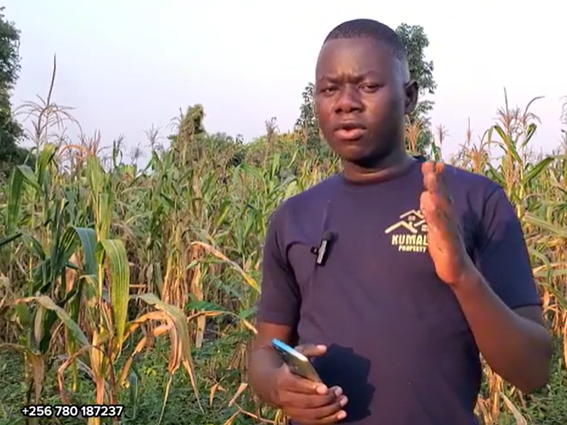
Presented in a short video, “Cost of Growing 1 Acre of Maize in Northern Uganda,” apparently based on the experience of a female maize grower, with 10 acres of maize in Omoro District, in Acholi Region, Charles Layoo educates:
Maize performs well in Northern Uganda, which has two maize growing seasons (in March and in July/August). In any season, Layoo estimates production costs for growing an acre of maize at Shs. 600,000, broken down as follows:
- Shs. 100,000 for leasing land.
- Shs. 30,000 for land clearing
- Shs. 90,000 for ploughing using ox plough.
- Shs. 80,000 for buying maize seed (Shs. 40,000 per bag; 2 bags need).
- Shs. 300,000 for hiring labor (planting, weeding and harvesting).
Layoo’s estimates, noticeably, are without costs for necessary inputs. And he seems to assume the investor is able to do own supervision and administration. Nevertheless, all suitable factors met, from an acre of land, Layoo estimates a harvest of 15 bags of maize (each120 kilograms); as in 1,800 kilograms.
He assumes a sales price of Shs. 1,000 per kilogram; suggesting feasibility for a farmer, during a farming season and from one acre of land, to generate Shs. 1,800,000 in gross income, before taxes.
Agmore Maize Farming Productivity Calculations
Agmore (agro and more) Kisoboka website, “Cost benefit analysis for maize / corn farming,” estimates costs of growing an acre of maize – “BAZUUKA, DK 9089/777, Longe 10H, DT MAX, CHAMPION, KENYAN HYBRIDS, varieties at Shs. 2,170,000; broken down as follows:
- Shs. 200,000 for leasing land per season.
- Shs. 150,000 for land clearing
- Shs. 200,000 for ploughing using a tractor.
- Shs. 120,000 for buying maize seed (10 kilograms).
- Shs. 850,000 for buying other inputs (Basal fertilizer, Selective Herbicides, Foliar Fertilizer and Insecticide).
- Shs. 600,000 for hiring labor (digging holes, planting, spraying and harvesting – 1 person at Shs. 150,000 per month for 4 months).
- Shs. 200,000 for supervision and administration
- Shs. 100,000 for miscellaneous
Of important note is the additional advisory that Agmore gives for an investor to “plan to have plenty of water either via irrigation or rain water”
For a one-acre maize income generation activity, Agore estimates production costs of Shs. 2,170,000; harvest of 3,800 kilograms; sold to generate Shs. 3,800,000 in gross income. An investor thus earns profit of Shs. 1,730,000; a 45.5% profit margin, before taxes.
Productivity of Apio’s Maize Activity
How I understood it. Apio’s story implies it is feasible for a farmer in Lira District, or the wider Lango Northern Region, to grow three acres of maize at a production cost of under a million shillings; moreover, utilizing a PDM loan.
What was the cost of Apio’s PDM Loan?
Information online, credited to the Economic Policy Research Centre as the source, enlightens that the cost of borrowing Shs. 1,000,000 of PDM funds is at 6% per annum, Shs. 5,000 per month, or Shs. 60,000 per year.
For an agricultural loan, such as for farming maize, the borrower is “typically given a grace period of two years, before starting full repayments.” And that the repayment loan period is typically “structured around the gestation period of the agricultural enterprise (typically 3 years).”
This means the interest charge on a PDM loan of Shs. 1,000,000 for farming maize, could be Shs. 20,000 (for four months of one farming season) or perhaps, Shs. 180,000 (for 36 months gestation period of agricultural enterprise).
Whereas, it is policy for PDM loans not to attract administrative charges, I wonder why Akello left Shs. 30,000 in the bank. Is it for the interest payment, as in the bank withheld the interest charge in advance?
Well, stories abound about the uphill task of getting to the point of access of PDM funds. For example, such as costs for obtaining a National ID, if she did not have one (transport to and from a NIRA center and mobilizing requirements).
Don’t forget the costs for obtaining own registered phone number in own name.
Then there are those costs one has to incur to fulfill the lengthy group requirements before the funds are disbursed; and in order to access the funds when they are disbursed.
It is important to include all loan accessing costs in the analysis, so as to get a more accurate determination of productivity. Costs incurred to access the loan are missing from the clip of Apio’s success story.
What were Apio’s true maize production costs?
Even with the lower estimate, the one by Layoo, of Shs. 600,000 per acre, it seems unlikely Apio’s cost of production for three acres of maize came under a million shillings. Her production costs were likely Shs. 1,800,000 or more.
Supervision and administration are instrumental for production success and determining productivity. Often neglected by many income generators in Uganda. As did Layoo’s estimate, and seemingly as did Apio’s testimony.
It is the reason that I find it more believable that Apio’s true cost of production for her three-acre maize activity would have been closer to the comprehensive Agmore estimates of Shs. 6,510,000 for three acres of maize.
What was Apio’s harvest?
Akello could have attained the lower harvest estimate of 5,400 kilograms of maize by Layoo. Contextualized, within an assumption his lower production estimates show insufficient adherence to relevant best agronomic practices.
From her testimony and in Layoo’s estimates, no provision was made for use of significant inputs – fertilizers, pesticides, among other important factors of production left out of the testimony and analysis.
Consequently, I find difficulty to believe Apio’s production achieved a higher harvest of 11,400 kilograms of maize from three acres, as estimated by Agmore.
How much income did Apio earn
Insinuating that in one farming season Akello could have sold her maize and earned a gross income of Shs. 5,400,000, the lowest estimate, is difficult to believe.
It seems unlikely that Apio’s low level investment made her a profit of Shs. 3,600,000, before taxes; and which is double her investment, as per Layoo’s estimates.
Using Agore estimates, Apio could have potentially generated gross income of Shs. 11,400,000 from her three-acre maize operation; earning Shs. 4,890,00 in profit, before taxes; a 42.9% profit margin. All considered, it is unlikely she did.
The likelihood of an investor attaining a 42.9% profit margin from maize production, as Agmore estimates, is believable. This is as opposed to a profit margin of double the investment, as estimates by Layoo and seemingly Apio’s testimony suggest; which is highly unbelievable.
Conclusion
Is it truly feasible for a farmer to invest such low amounts of money to grow maize; and succeed in obtaining a bumper harvest; which harvest she can sell and earn a huge profit, double the investment? I have my doubts.
Apio’s story seems a factoid. Sadly, factoid riddled accountability has become normalized in Uganda. Duty bearers, such as legislators, members of parliament, who are delegated to represent us, the people, to hold implementers and the Executive to account, are instead seemingly ‘sleeping on duty’.
A cursory view of legislators ‘listening’ to and ‘receiving’ the Address does not inspire confidence. A significant number of them did not seem to follow the central logic of the Address; and to notice the contradictions within it.
If Apio’s story be the best example there is from Northern Region, it is discomforting.
Use of Apio’s case to exemplify success of government programs in Lango Region, surely, ignites curiosity on what it truly indicates. Particularly so, in comparison with success stories from the Greater South similarly shared.
Inclusion of PDM beneficiary Apio’s story among success stories profiled as part of the State of the Nation Address 2026, ironically, may be a symptom of unethical practice among public servants (technocrats and politicians alike), who are ‘sleeping on duty’ and not fulfilling their mandate.







Let’s Chat…