
“Against the humiliating bondage of a thousand years, rapacity came from afar to subjugate them for a hundred years. Against the cynical malice in the shape of neo-colonialism and its petty local servants. Many gave in and certain others resisted, but the frustrations, the successes, the sweat, the blood, have fortified our courageous people and fertilized its heroic struggle.” 1st Stanza Burkina Faso National Anthem
The English translation of the Burkina Faso anthem speaks volumes.
Folklore holds that the former president of Burkina Faso, late Thomas Isidore Noël Sankara, aka Thomas Sankara (1949-1987), was an accomplished guitarist and he wrote the national anthem for his country.
No wonder, the Burkina Faso Anthem, specifically and clearly reminds the world that the colonial period and neo-colonialism must not be forgotten.
“And one single night has drawn together the history of an entire people, and one single night has launched its triumphal march. Towards the horizon of good fortune. One single night has brought together our people with all the peoples of the World, in the acquisition of liberty and progress. Motherland or death, we shall conquer.” Chorus Burkina Faso National Anthem
Sankara used his country’s anthem to be a clarion call to remind his people of their humanness and of being part of the human race. To decolonize their minds of their dehumanization while under colonization.
Nourished in the lively source of the Revolution, the volunteers for liberty and peace with their nocturnal and beneficial energies of the 4 of August had not only hand arms, but also and above all the flame in their hearts lawfully to free Faso forever from the fetters of those who here and there were polluting the sacred soul of independence and sovereignty. 2nd Stanza Burkina Faso National Anthem
In the second stanza Sankara justified and explained the need for his country’s hard-earned independence from France on 4th August 1960:
During Sankara’s reign, he practiced what he preached. For instance, he:
- Spoke in forums like the Organization of African Unity against continued neo-colonialist penetration of Africa through Western trade and finance.
- Built roads and a railway to tie the nation together, without foreign aid
- Called for a united front of African nations to repudiate their foreign debt.
- Argued that the poor and exploited did not have an obligation to repay money (national debt) to the rich.
“And seated henceforth in rediscovered dignity, love and honour partnered with humanity, the people of Burkina sing a victory hymn to the glory of the work of liberation and emancipation. Down with exploitation of man by man! Forward for the good of every man by all men of today and tomorrow, by every man here and always!” 3rd Stanza Burkina Faso National Anthem
Sankara defined and made a call to action to the people of Burkina Faso to revel in their humanity and never to allow another to take it away from them. Which explains his egalitarian actions while he was president.
- Sold off the government fleet of Mercedes cars and made the Renault 5 (the cheapest car sold in Burkina Faso at that time) the official service car of the ministers.
- Reduced the salaries of all public servants, including his own, and forbade the use of government chauffeurs and 1st class airline tickets.
- Converted the army’s provisioning store into a state-owned supermarket open to everyone (the first supermarket in the country).
- Forced civil servants to pay one month’s salary to public projects.
- Refused to use the air conditioning in his office on the grounds that such luxury was not available to anyone but a handful of Burkinabes.
- Lowered his salary to $450 a month and limited his possessions to a car, four bikes, three guitars, a fridge and a broken freezer.
- Redistributed land from the feudal landlords and gave it directly to the peasants. Wheat production rose in three years from 1700 kg per hectare to 3800 kg per hectare, making the country food self-sufficient.
- He opposed foreign aid, saying that “he who feeds you, controls you.”
- A motorcyclist himself, he formed an all-women motorcycle personal guard.
- He required public servants to wear a traditional tunic, woven from Burkinabe cotton and sewn by Burkinabe craftsmen. (The reason being to rely upon local industry and identity rather than foreign industry and identity)
- When asked why he didn’t want his portrait hung in public places, as was the norm for other African leaders, Sankara replied “There are seven million Thomas Sankaras.”
“Popular revolution our nourishing sap. Undying motherhood of progress in the face of man. Eternal hearth of agreed democracy, where at last national identity has the right of freedom. Where injustice has lost its place forever, and where from the hands of builders of a glorious world everywhere the harvests of patriotic vows ripen and suns of boundless joy shine.” 4th Stanza Burkina Faso National Anthem
In the fourth stanza Sankara defined his country’s vision. And he went about achieving it. For example:
- Vaccinated 2.5 million children against meningitis, yellow fever and measles in a matter of weeks.
- Initiated a nation-wide literacy campaign, increasing the literacy rate from 13 percent in 1983 to 73 percent in 1987.
- Planted over 10 million trees to prevent desertification
- Appointed females to high governmental positions, encouraged them to work, recruited them into the military, and granted pregnancy leave during education.
- Outlawed female genital mutilation, forced marriages and polygamy in support of Women’s rights.
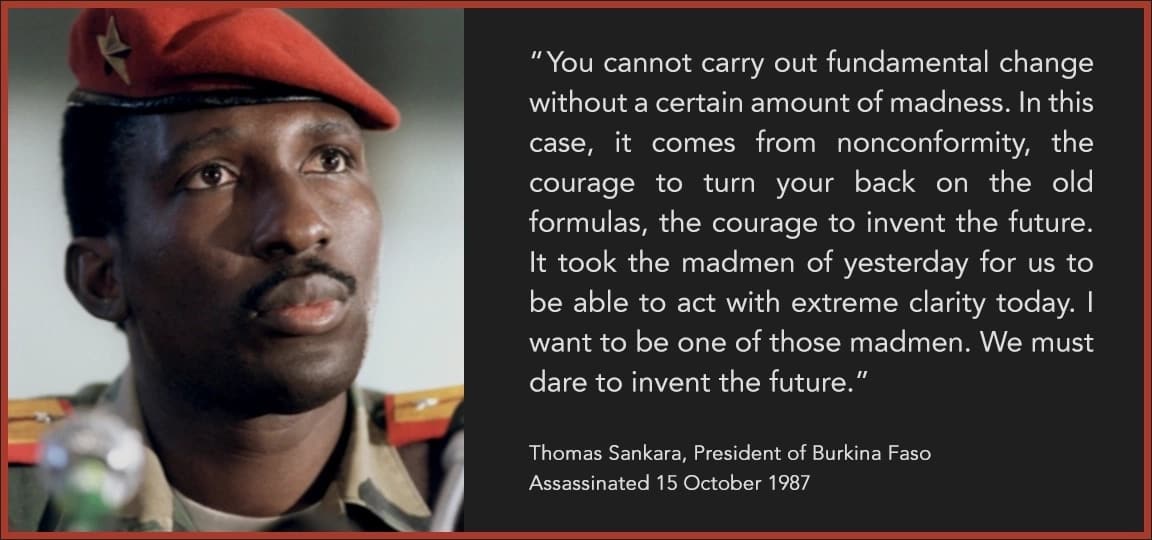
Source of information about achievements of Sankara @ African and Black History
Indeed, unlike the anthems of many African nation states, such as my own, Uganda, which typically gloss over the traumatic colonial period and its sustaining legacy on the continent.
Perhaps this could be the explanation for the governance challenges which dog Africa. Having national anthems that are generally meaningless to the masses. What do you think?






Let’s Chat…