
“The caloric intake of 62.1 percent of Ugandans is below the country’s recommended dietary intake of 2,200 calories per person per day,” it is reported.
Many do not have sufficient access to food in Uganda because of our inefficient food system. In Uganda we are quite happy to give tax holidays to foreign owned businesses to import food supplements into Uganda, for example.
Worse more, it has been known for Ugandans to prefer feeding their children on fancy food supplements, rather than pay a smallholder farmer the fair price for fresh foods – vegetables and fruits and others.
It is all about ones social standing – their class. The ones whom information adverts target, such as, the one which encouraged people to be faithful to their spouses lest they contract HIV and AIDS, die and their children end up eating cassava; while the other children will be eating chips (French fries).
Moreover, locally produced food is produced in a more environmentally friendly manner and has the same or even better food value than food supplements.
Many in Uganda are also food insecure because they have insufficient access to food that is culturally acceptable to them – that which they procure without any loss of dignity or self-determination.
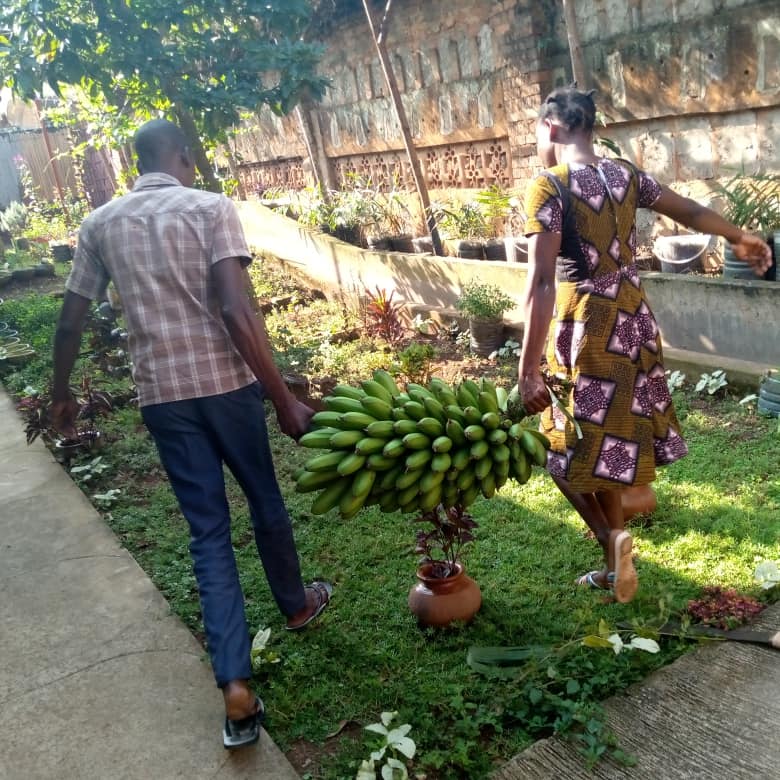 FOOD FOR THOUGHT 1: “I visited Masaka villages about a decade ago as part of a monitoring team for a DANIDA project on household agricultural support. We found an old lady who told us her household would die of hunger if government did not come in to their rescue. They did not have food, so she said. On further probing, we discovered that she had a shamba of sweet potatoes but they were rotting in the garden as no one wanted to eat potatoes and there was no market for them in the area. To her, food was matooke, a crop that no longer yielded well in the area. To address food insecurity concreretely and sustainably, there is a clear need to address mindsets (Mubarak Mabuya, 2014).” Photo @ Couple carries home freshly harvested matooke.
Meaning, for example, that many in Buganda are food insecure simply because they prefer to eat matooke. But because they can’t afford matooke any more they are forced to eat foods such as posho, akalo, and cassava, which they can afford.
Ironically, cassava is a major staple food in Uganda and yet it is considered the food of the poor. Among Iteso, my people, a family is insecure if they do not have cassava in stock and or in-field.
So, for example, when in 2008, Iteso experienced famine that was caused by flooding which submerged food crops, Iteso were more offended by comments of government officials who suggested that Iteso should eat lizards and leaves.
Lizards and leaves of several wild plants and crops that we grow are a great source of nutrition. In the past, Iteso ate cassava leaves, potato leaves and a range of leaves of wild plants, but they no longer do so. Likely, because it is considered a sign of failure in providing for one’s family, if they are seen eating leaves.
People would rather go hungry or will be malnourished just because they won’t eat edible food items which are socially considered inferior. Eating edible rats, for example, is now frowned upon and yet these rodents would be a great source of nutrition for many who frown upon them.
Sadly, our policy makers do not help with their categorization of significant sections of the population as ‘backward’ needing education on what is considered food. When, our policy makers should instead be appreciative of our diversity of food sources, document them, and popularize them.
Appropriate research intended to propel appreciation of our diversity of food sources, is what our food related research institutes should be doing. And not promoting the bad kind of genetically modified foods.
But, instead, Uganda is gifted by nature and yet millions are hungry.
FOOD FOR THOUGHT 2: “I think you are right to say that, the challenge on the table is perception and training programs not tailored to suit our domestic nutritional demands. I will agree with you Norah, that training programs that lean on Western style nutritional diets will not be easily replicated over in our local environment. Thus, an urge is absolutely eminent to develop nutritional guides based on local nutritional material. From the perspective of an African, we should have books telling us the sources of protein, carbohydrates, iron, vitamins, etc., to include ingredients like grasshoppers, flying ants, baked soil, rats, game meat or commonly known as bush neat, leafy vegetables, root tubers, grains and seed (Charles Matege, 2014).”
FOOD FOR THOUGHT 3: “Norah, for your good work, develop a sensitization campaign on what I will loosely call Household Food Planning. Many of the starving households in the areas I know produce enough food to last a whole year, but grossly mismanage it. So, you find food stocks lasting for 9 months or less instead of 12 months. Well, we know there is poverty, we also know climate change challenges, but to be in perpetual want of food, which one is capable of producing adequately, to say the least, is a gross lack of planning on the part of people who suffer from lack of food year in year out (Max, 2014).“




 the Humanist view
Let’s Chat…