
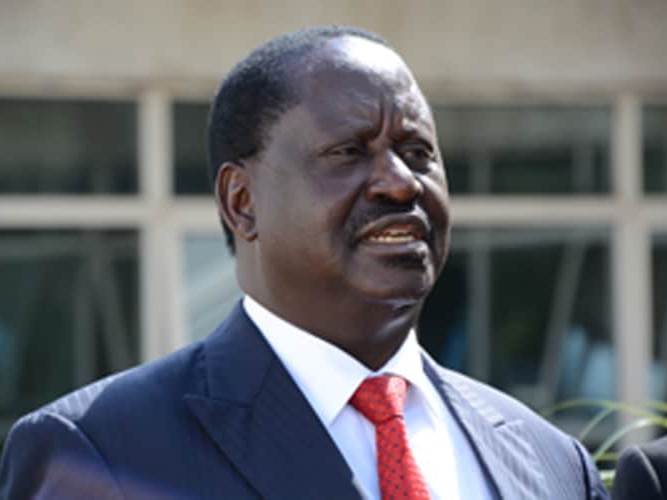
Multiparty democracy is as good as its democratic institutions. Multiparty democracy can thrive or not depending on the powers the Constitution gives to the Executive, it gives to Parliament, and it gives to the Judiciary. And how people who hold positions in those arms of government exercise power.
Within Kenya the institutions are working. Late Raila Odinga is credited for the 2010 progressive Constitution of Kenya. Irrespective of whether it is followed closely, but it set into pace the different arms of government in Kenya to operate independently and are respected in their own right.
Some people, case in point, were trying to say: “for us in Luo culture, it takes so many days or months before you bury a deceased elder, such as late Raila.” The Judiciary of Kenya, an independent Judiciary, came in and said no. You are not going to disobey or disrespect the last Will of late Raila. You will follow his wishes and bury him within 72 hours.
That is how an independent judiciary operates. And therefore, the nation state Kenya, the family, everybody had to do everything they could to fulfill late Raila’s wishes and it was done.
For context, read: “Abiriga burial program interrupted over security concerns”
For context also read: “Abiriga to be buried Monday.”
Comparing with Uganda’s current activity for the 2026 election, the situation in Kenya becomes interesting. There was first an election. And irrespective of the fact that late Raila thought he had won the election, another candidate was declared winner.
The other candidate was brought to the table and there was a negotiation to have a broad-based government. Because then you realize that the other person has a following and this person also has their following. Let us agree to govern together for the good of our country, kind of foresight.
Those were the things late Raila was known for. He was known for fighting for democratisation. He was unrelenting – he was like: “this is the law, we must follow the law, we must follow the democratic principles.” That is his legacy.
His legacy is an interesting one and full of contradictions. Late Raila himself came from a family of influence. His family was not the ordinary, I have come out of the ghetto type and risen. He came born into a family that had a lot of influence, that was powerful, that was rich.
But somehow, his actions, earning him the title of “baba,” are that he constantly, wanted to make sure that inequalities are not allowed to flourish in Kenya. He fought for the ‘have-nots’. He was seen to fight for the disenfranchised, that is where you would find him; earning him the accolade “baba.”
This is a leader who did not have to align himself with the “unwashed masses” as some people call them. But he insisted that the law has to work the same way for everybody.
Multi-Party Democracy in Uganda
Opposition leaders are operating within the current system where it seems the Constitution has provided significant power to the Executive.
We have a situation where opposition party leaders have come out and said we are going to campaign for President Museveni, and at the same time we are going to campaign for our own members of parliament (MPs) and local government leadership candidates.
Why then do we need all opposition parties, in excess of 27, if they are unable to field their own presidential candidate?
I do not believe that the decision of the party heads represents the decision of their party members. We are yet to hear that there was a resolution during a general meeting of Uganda People’s Congress (UPC) or of the Democratic Party (DP), for example, where they resolved to campaign for President Museveni.
It defeats the whole argument of multiparty democracy. This situation where opposition parties before even going through the 2026 election are declaring an alliance with the ruling party raises a question mark for many.
That opposition party leaders have decided to back President Museveni tells me that as individuals, they have negotiated their political future to hang on to President Museveni. It is through President Museveni they see a political future for themselves.
I do not feel that this is an inter-party deal where we say let us campaign together so that we can govern together.
Look at Lira City. It has UPC, the president of UPC Akena and his wife, Hon. Amongi, UPC flag bearer for Woman MP Lira City, is a minister in the current cabinet of President Museveni. The NRM candidate for Woman MP for Lira City, Hon. Aceng is also a cabinet member.
UPC is presumed campaigning for President Museveni and UPC is also campaigning for Hon. Amongi. It is not clear the parties are necessarily aligned in terms of National Resistance Movement (NRM) together with UPC. It is much more the individuals. And that is the difference between Uganda and Kenya.
What is the role of party presidents who are forming allegiance with another party president?
I raises concern that parties preparing to be the next government fail as opposition parties together to form a coalition. When National Unity Platform (NUP) won the majority number of opposition MPs in Parliament, when they got into Parliament, they did not work very well with the other opposition parties.
Therefore, providing that gap to President Museveni. And loosing the opportunity to consolidate its gains. People Power was a movement, a big movement, which was cutting across many political divides. People Power was hijacked and turned into the NUP political party.
NUP was not a new political party. It was an old political party, National Unity, Reconciliation and Development Party (NURDP), which was bought by current leadership of NUP, that is what they say. And then it was turned into a separate thing from People Power. But galvanized by the movement of People Power.
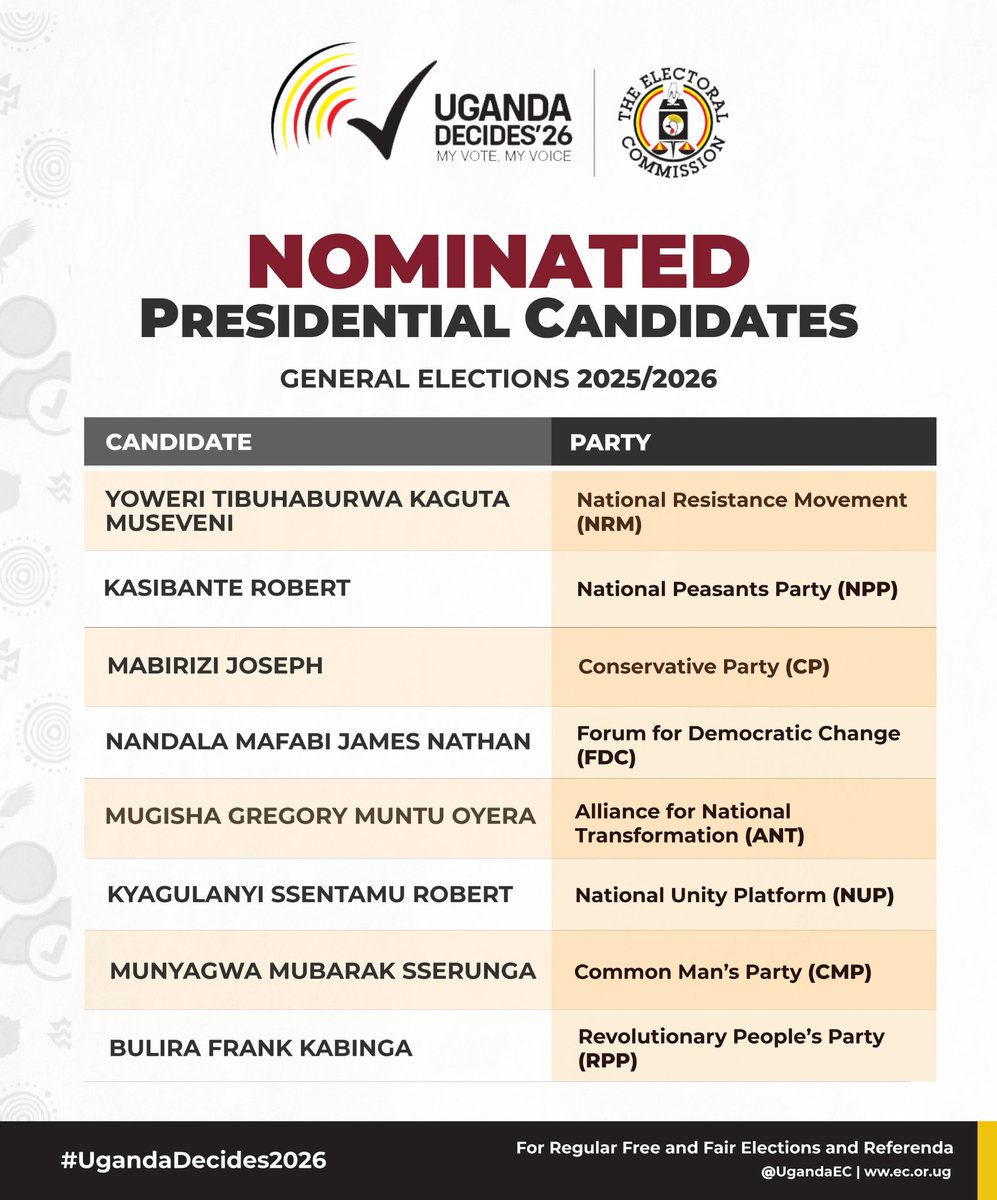
If you look at all the parties that have fielded a presidential candidate, you might actually find out that the Alliance for National Transformation (ANT) is the newest party. Others are small old ones, some of which have now been bought off by rich people and turned for their personal gain.
Opposition political parties that are saying they are campaigning for President Museveni are making an economic decision, because the parties they bought are theirs. They bought them like you buy a company on the sock exchange. These parties were not formed from the grassroots up.
If you ask: who are the original founders who registered that political party, do they agree with the current owners? You will find that it is not the case. I understand, for example, that even up to now, NUP is still in Court to determine which Constitution is actually operational in NUP.
Read more in “Breaking: Judge warns Kibalama after case against NUP fails to take off again.” It is adjourned to April 13, 2026. The prevailing status quo is “Court orders preservation of original NUP Constitution (of 2024)”
Democratic Governance in Uganda
Operators within the other arms of government seem to have assumed that it is their role to be yes people, or yes men or yes women.
We have a situation in Uganda where many feel that unless President Museveni himself as person, individually, not the National Resistance Movement (NRM) party, but President Museveni, individually as person steps in, something will not be done. And that is a dangerous situation for us as a state.
Case in point, we cannot ignore the situation right now where we the ordinary people are feeling that the Judiciary itself is not independent. We need an independent judiciary that sticks to judicial doctrine, the law. And say, this is what the law says and this is what has to be done in accordance with the law.
Right now, for example, we have a situation in which the Judiciary seemingly is the one that is doing things that actually go against the law. I use an example to substantiate. We have a situation in which the Uganda Law Society (ULS), the national Bar, is in direct conflict with the Judiciary.
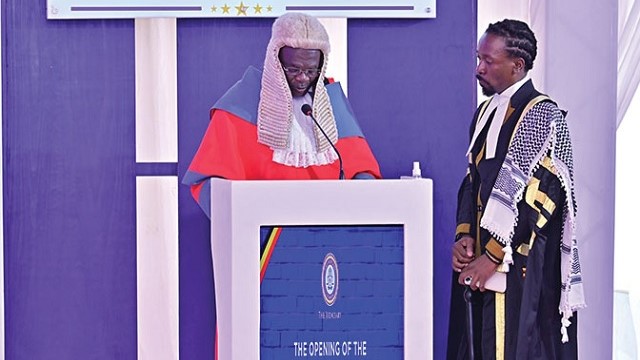 During the opening of the Law Year, when Chief Justice Owiny Dollo refused the Uganda Law Society President Isaac Ssemakadde a chance to speak as is the tradition. And in his characteristic rebel Radical New Bar bang the table style the latter confronted the former.
Currently, there is the Judicial Service Commission (JSC) and that JSC is not fully constituted, because the members of ULS have not been permitted or allowed to vote for their representatives to the JSC. But this JSC is preparing to vet and get a new head of the Judiciary, even when it is not fully constituted.
In Uganda, you hear people say, going to Court is a waste of time, because the Courts will decide however. People, in fact, fear to go to Court. Lawyers themselves, senior lawyers, who have practiced for over 15 or 20 years say there seems a different set of laws for rich people and another for poor people.
“If you go the Health Centre IV you have to go out to buy nearly all medical supplies needed to treat you,” a concerned citizen from Serere District lamented. Another observed that people who are talking about “Protecting our Gains” are simply people who have stolen the money.”
Such inequalities where people go to a health center IV and find no medicines. While our leaders when they fall ill, a lot of public funds are used to fly them out, because there is no medicine in Ugandan hospitals.
The class system is so present. The class divide is there. In order to emulate the legacy of late Raila, we need to have people in political leadership who try as much as possible to fight inequalities and abide by rule of law.




 Humanist
Let’s Chat…