

Spiritual Poverty
Government is not the giver of rights to the people. It is the people who are the source of the government’s legitimacy. Sadly, people at the grassroots in Africa do not believe that they are the source of the government’s legitimacy.
They are suffering from spiritual poverty, sustained by a psychological feeling of inferiority, that does not allow them to participate fully in the governance of Africa.
Similarly, those in government and leadership, in general, in Africa do not believe that the source of their legitimacy is the people or that they are answerable to the people of Africa. By “leaders in general,” I mean all of us:
- Extension workers
- Members of parliament
- Non-government (NGO) staff
- Anybody in a leadership position.
We govern with an attitude of superiority that encourages us to believe that we are doing the people at the grassroots a favour.
Strengthening good governance
We need to raise the consciousness of our people at the grassroots. They need to look inward to:
- Establish why they have a psychological feeling of inferiority
- Grapple realistically with their problems
- Attempt to find solutions to their problems
- Develop a conscious awareness and physical awareness of their situation
- Analyse their situation and provide themselves with answers
The foundation of all development is human development. Unfortunately, this sector is neglected in Africa.
The rebuilding of Europe after World War II was successful because the human resources were there. When the Europeans were given development assistance, they had the human capacity to manage that assistance.
In Africa, it is different. The aid is given to us not to utilize the way we would like, but with the technical people who tell us how to utilize it. In Uganda, and in Africa, in general, we need to focus on the grassroots first.
For example, people have complained: “we do not have tractors, we do not have technologies, we do not have large infrastructure.” But, if we have that infrastructure and do not have a sophisticated human base, we are wasting our time.
Unfortunately, development aid tends to go to the roof, without looking at the foundation. We have invested a lot in ensuring social development, without realizing that social development can be sustained only if we have good political development and solid economic development.
And those two pillars – political and economic development – can be sustained only if the people are empowered. It is my conviction, for example, that cooperatives in Uganda were not very successful, because they tended to be top-down instead of bottom-up.
Leaders of cooperatives would present balance sheets in English with complicated terminology, and the farmers did not understand what was happening. That is the source of corruption. It is difficult to prosecute, because it is difficult for us to even detect the corruption.
Among our biggest challenges in Africa are illiteracy and ‘development AIDS,’ which is aid-induced dependency thinking. There is need to stimulate processes of consciousness raising, not only at the grassroots level, but also for us as leaders.
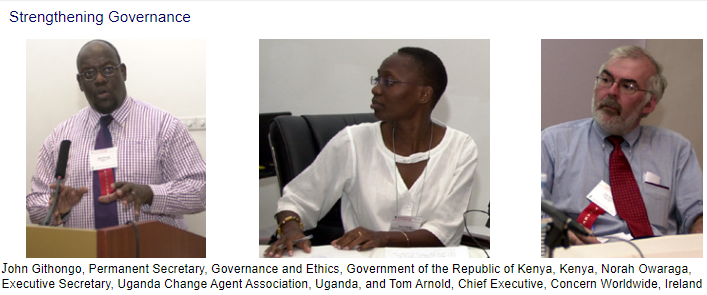 This text is of a presentation that I researched, prepared and delivered during the all-Africa conference on “Assuring Food and Nutrition Security in Africa by 2020 – Prioritizing Actions, Strengthening Actors, and Facilitating Partnerships. At the time, 1st to 3rd April 2004. My contributions are included in the report under Chapter 16, Strengthening Governance, pages 180-182.
 A PDF of the proceedings of the conference is available to download from the USAID website.
First published on 13th September 2024. The published today, 31st October 2025, for its relevance in the context of the current status quo in East Africa – It is election season and the relationship between the leaders and the led aren’t clear to them – in Tanzania, in Kenya and in Uganda, especially.





 the Humanist view
Leave a reply to pius2018 Cancel reply