In recent times I have read and listened to my fellow Ugandans bash traditional media for not being pro-active and at the forefront of the fight against corruption in Uganda. Branding traditional media – print, radio and television as antiquated in comparison posts of ‘anti-corruption warriors’ on social media.
A major ad hominem critique of Uganda’s traditional media in this regard is that it has been bought and is incapable of objectively writing against ‘the powerful’ in the public and civil service. As in journalists working for traditional media houses have been muzzled through bribes and rent seeking for advertising revenue by the respective media houses that they work for, the critique goes.
I find such critique curious, especially so when it is argued that the ‘anti-corruption warriors’ on social media are the pure ones and not muzzled by benefactors. I wonder, who pays for the activism of social media anti-corruption warriors? The cost of internet data alone for them to maintain such active presence on social media is significant in the context of Uganda. And the time which they invest in maintaining presence on social media is a lot.
If social media ‘anti-corruption warriors’ are pure and are not earning in anyway from their social media activism, how do they survive in our severe Uganda economy? How do they put food on the table for their families? How are they able to afford all the necessities of life?
Be that as it may, as for me, the more valid and the more useful actionable information against corruption in Uganda I have gotten via traditional media. Let me use the example of the Members of Parliaments (MPs) Service Award saga, to elucidate. Half truths about the MPs service award are wash on social media. Reported as jaw-dropping corruption in parliament. However, the manner in which the saga is reported and discussed on social media is not actionable.
For the most part, social media posts by ‘anti-corruption warriors’ did not unequivocally demonstrate how the self-allocation of billions of shillings by MPs in service awards is corruption. After all, MPs are allowed by law to determine their own remuneration.
The lamentation on social media instead provided room for the accused, beneficiary MPs, to divert the narrative away from their conduct within the wider definition of corruption. The benefiting MPs instead used the social media lamentations to play victim of politically motivated attacks.
I dare surmise that none of the information published on social media by ‘anti-corruption warriors’ would stand in a court of law as viable evidence of corruption in the matter of MPs service award. If utilised as the evidence in a court of law it would have ended similar to how court ruled in favour of Uganda Revenue staff who each got 200 million shillings in ‘presidential handshake’ saga.
In comparison, reporting in traditional media on MPs service award I find goes beyond lamentation. Traditional media is providing educative and deeper analysis on why MPs service award is corruption and how successful legal action against errant members of parliament may be taken.
Case in point, Daily Monitor sought for a legal opinion from Ms. Lillian Drabo, an Advocate, that it published.
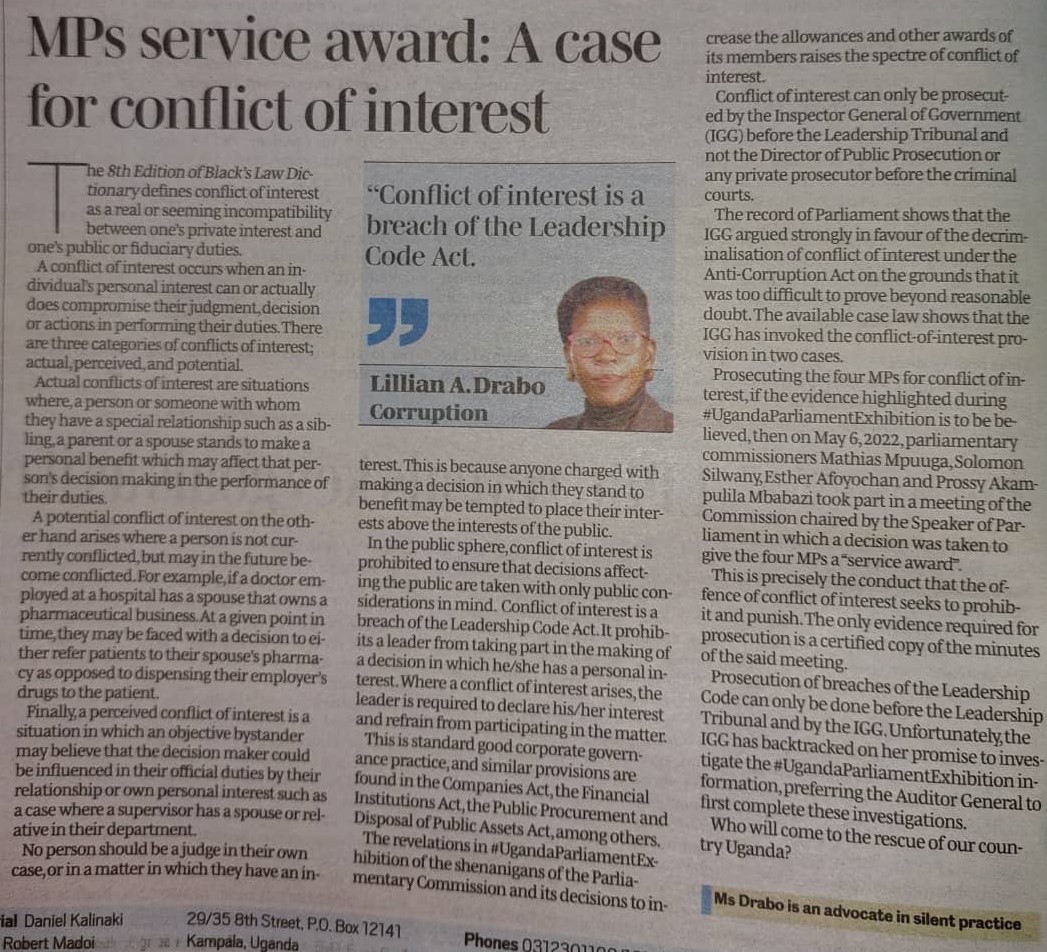
In her legal opinion Ms. Drabo educated on how conflict of interest of MPs could be proven. And when proven they would be guilty of breaching of the Leadership Code Act; and therefore corruption.
“In the execution of official government business, a public officer shall not put himself or herself in a position where his or her personal interest conflicts with his or her duties and responsibilities as a public officer… A public officer or any member of his or her family shall not solicit or accept valuable gifts, presents, hospitality gratuity or favour or other benefits, if he or she has reason to believe that the acceptance of such gifts, presents and other benefits is bound to influence his or her judgement or action in a matter he or she is dealing with or will handle in future.”
The Code of Conduct and Ethics for the Uganda Public Service.
Clearly, members of parliament who benefited from the service award bonanza put their personal interests above those of the public by accepting the gift of the service award; another benefit in addition to their remuneration for services rendered. This can be proven through the minutes of the meeting at which they so decided to award themselves huge sums of money, as Drabo educates; through payment vouchers; and bank transactions.
Furthermore, my learning from Drabo’s legal opinion is that there was and there is still insufficient outrage on social media against the Office of the Inspector General of Government for its inaction and neglect of duty.
“Prosecution of breaches of the Leadership Code can only be done before the leadership tribunal and by the Inspector General of Government.”
Ms. Lillian Drabo, Advocate.
It seems to me the ire of social media ‘anti-corruption warriors’ on the matter of MPs service awards in equal measure or even the more should have focused on the Inspector General of Government.
Sadly, as it is current, at the end of the day, the real beneficiaries of activism on social media by ‘anti-corruption warriors’ seem the activists themselves and those accused. The activists benefit by gaining larger than life personal profiles as presumed experts on transparency, accountability and anti-corruption; when in reality they ain’t.
While, the accused benefit from retaining their loot from the public purse, ill-gotten gains via violation of our nation’s leadership and ethics codes of conduct.






 the Humanist view
Let’s Chat…