
The type and quantity of food that is good for Mukebezi, a smallholder farmer in Pallisa in Uganda, who weeds her farm, garden if you will, using a handheld hoe may be different from that of Alinga, a corporate executive from Pallisa who earns her livelihood seated behind her desk most of the day doing computer work.
The daily caloric intake that Mukebezi needs is surely higher than that which Alinga needs.
“A calorie is a unit of energy. In nutrition, calories refer to the energy people get from the food and drink they consume, and the energy they use in physical activity… Adults typically require between 1,600–3,000 calories per day. However, this varies depending on a person’s sex, age, height, and lifestyle. If we consistently take in more energy than we need, we will gain weight. If we take in too little energy, we will lose weight, fat, and eventually muscle mass.”
Medical News Today
Assuming, for arguments sake, that because of her active lifestyle, Mukebezi needs and consumes food that enables her to have a high caloric intake of 3,000 per day. With her sedentary lifestyle, if Alinga were to eat the same food types and in the same quantities as Mukebezi and thus consuming the same caloric intake, Alinga would most likely take in more energy than she needs.
In which case, Dr. Kasesne’s advisory may be valid for Alinga that consuming large quantities of millet and maize ugali is a “quick way to plan for diabetes in the near future.” However, this advisory may not necessarily be valid for Mukebezi.

Conversely, for arguments sake, assuming that because of her sedentary lifestyle, Alinga needs and consumes food that enables her to have a low caloric intake of 1,600 per day. With her active lifestyle, if Mukebezi were to eat the same food types and in the same quantities as Alinga and thus consuming the same caloric intake, Mukebeiz would most likely take in less energy than she needs.
In which case Dr. Kasenene’s recommendation of a grain and starch free diet may be valid for Alinga, but it may not necessarily be valid for Mukebezi.
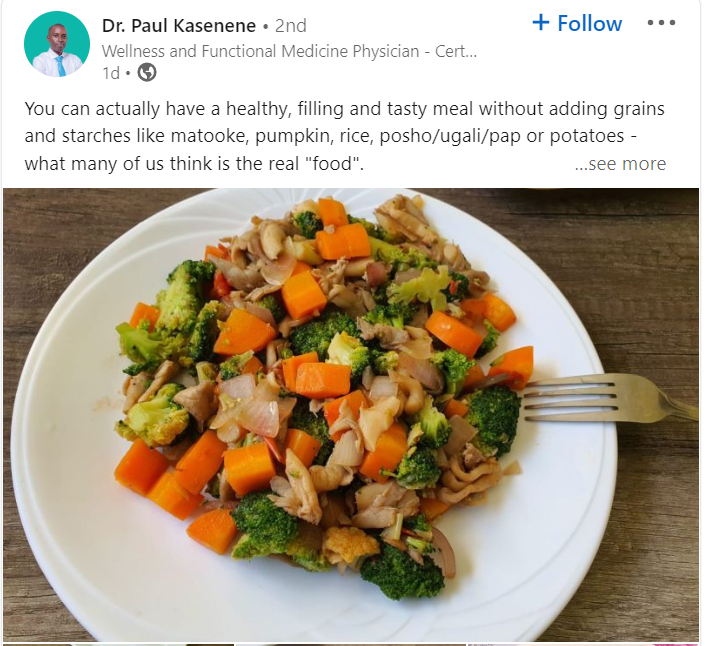
When doling out dietary advice, me thinks, it is important for whoever is doing so, especially if they be a medical doctor, to clearly specify for whom the advice is for. It is lazy and dangerous for a medical doctor to use the powerful tool of social media to give advice valid for some, but present it as though it were valid for all.
Some may think this post overreacting to Dr. Kasesene’s advisories. After all, the majority of Ugandans on social media are urban dwellers and are of sedentary lifestyles as Alinga, one may surmise. Be that as it may, that the majority on social media are urban dwellers, still, this would be a foolhardy perspective to subscribe to.
Fact is, according to the Uganda Bureau of Statistics (UBOS) most recent Uganda National Household Survey, more households of Ugandans living in urban areas, 47% of them, are food poor as compared to the proportion of households of Ugandans living in rural areas, 22% of them, that are food poor.
Food poverty in this context is defined as the inability to have access to and consume food that one needs to obtain the minimum dietary energy requirement; as in their dietary energy consumption is below the minimum.
Minimum dietary energy requirements, according to UBOS, are “energy standards for different gender and age groups with sedentary physical activity levels and with minimum acceptable body weight for attainment of height.”
The minimum dietary energy requirement for Mukebezi and others with her lifestyle is different from that of Alinga and others with her lifestyle. For Mukebezi her health may actually only be guaranteed if she consumes “what many of us in Uganda think is the real food.” To advise her otherwise is a quick way in which to ensure her malnutrition related ill-health.




 the Humanist view
Let’s Chat…