
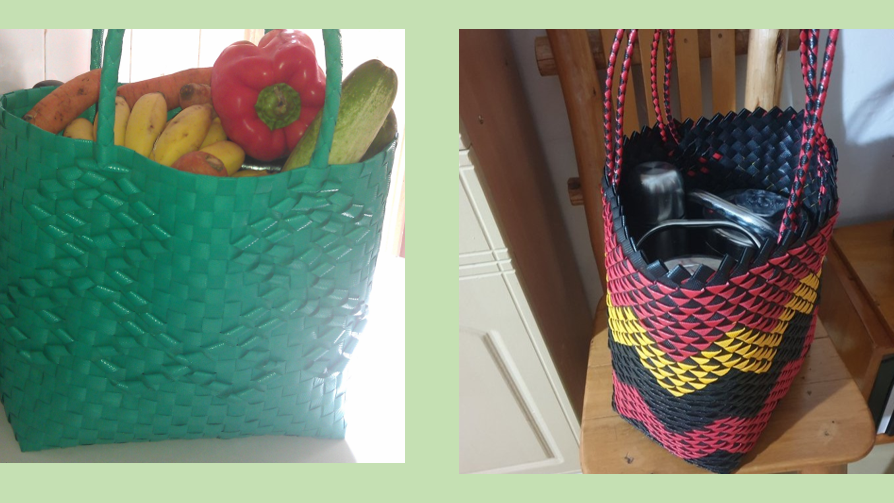
I feel so strongly about this issue because we, ordinary people, as opposed to government, can do something about it, if we were not so selfish and lazy. I recall as a young child, whenever we went with my mother to the market or to the shops, she always had shopping baskets (made out of palm leaves mostly). Our purchases were put directly in these baskets (various fruits, fresh foodstuffs, etc.) and when we got home we would sort them, wash them and put them in their respective storage places. The shopping baskets were cleaned and kept for the next time we went shopping. Even when the baskets become old and unusable, they were dumped in the garbage pit and they would decompose.
We had containers that could be re-used for storing items such as sugar, salt, tea leaves, cooking oil, etc. Instead of packaging these items in polythene bags, shop owners would expect shoppers to come with their re-usable containers and their purchases would be put directly in those containers. Paper bags were also more widely used as opposed to polythene bags. It is the old fashioned way, and in some cases cumbersome, but it is certainly a more superior choice in terms of preserving the environment.
Whenever possible, when I go to the market I go with a shopping basket and whenever I can, I will request the shop/stall attendant not to pack my purchases in a polythene bag. At least this is reducing the number of polythene bags that I use. In fact, also, whenever possible I re-use my polythene bags.
 My shopping bag that I bought from innovative young Uganda women that they made out of recycled polythene
I go the extra mile, as I am doing in this blog, to lament about the way polythene is destroying our environment to whoever, including to shop/stall attendants, my friends, my family, etc. Yes, my past experience of shopping as a child with my mother has some influence on the way I think now about how we, as adults, pollute the environment just by the way we shop.
Our selfishness and laziness is already destroying our environment and that of future generations. Moreover, we waste resources making the polythene bags, using them and trying to get rid of them. The rate at which we are using some of our resources and polluting air, soil, fresh waters and oceans must be reduced if we are to meet basic human needs both now and in the future. My experience of a garbage littered city, provokes a thought process – how come? Why? Isn’t there a solution?
Remember when the National Environment Management Authority (NEMA) finally decided to enforce a ban on polythene bags as shopping carrier bags? NEMA gave supermarkets and farmer markets a deadline to phase out polythene bags; and by the time the deadline arrived on 15th April 2015 they had seemingly complied. NEMA’s ban of polythene shopping bags did became one of the much talked about subjects, with many lamenting the crisis of no-bags for shopping.
- What does the Government want us to do now?
- How will we carry our shopping home?
- Why did the Government not first find an alternative for us before banning polythene bags?
The incredulous and purposeless lamentations went. Then the big shocker, in order to enforce the ban on polythene bags, the Government reportedly planned to compensate for loss of business those who invested in and had profited from producing polythene bags.
Baffling indeed, since, decades ago, it was very rare to see or find Ugandans using polythene bags to package and/or carry their shopping. However, these days, people go into a shop and/or market expecting their purchases to be packed in polythene bags. It is not uncommon for one to leave a shop with over 10 polythene bags each time they go shopping. After all, each item is packed separately in a separate polythene bag and then the smaller items, already packed in small polythene bags, are packed in bigger polythene bags (sometimes doubled up) for ease of carrying.
The problems come when the time comes to dispose the polythene bags. The traditional way of disposing garbage, which is still quite widely practiced in Uganda, is in garbage pits (hole in the ground). This system works well as long as the garbage disposed has the capacity to decompose. Polythene does not decompose. It is therefore a common site in Uganda these days to find piles of garbage.
Most city councils are suddenly faced with a huge task of finding other ways in which to dispose garbage. They find themselves with the need for more garbage trucks, which come with extra running and maintenance costs. The garbage trucks are required in order to ferry garbage to designated garbage sites. The designated garbage sites are also getting choked and soon there will be no where to dispose garbage.
There is also the added problem that people do not always dispose their garbage into the garbage pits, where it can be systematically collected. They just throw it anywhere, wherever the package was opened, or where the consumption took place. So, generally, you find large areas littered with garbage, especially polythene bags. The fact that polythene does not decompose is a danger in the sense that it chokes the land.
In addition, there have been several reports that polythene is threatening the lives of animals, particularly domestic animals, such as livestock, which feed on grass, peels, etc. There have been incidences in which disposed polythene bags have ended up mixed in garbage, such as green banana peels, which is fodder for animals such as cows and goats. By mistake the animals swallowed bits of polythene and choked to death.
Does the government have a policy? Why were polythene bags introduced in the first place?”






 the Humanist view
Let’s Chat…