
“It is one of the rare funeral rites where remains of a dead person are not brought from up country for vigils and prayers,” wrote Mr. Peter Okubal in comment to my “Fare thee well brother in love Okiring Eliot Daniel” post in which I wrote:
“The last journey of Dan’s remains here on earth has begun. This evening, Wednesday, 5th July 2023, there is a requiem service for his soul that will be held at his home in Lunnyo in Division A in Entebbe Municipality; followed by an all-night vigil.
Dan’s remains, however, will stay at Soroti Hospital until Friday, 7th July 2023, when the cortege bearing his remains is expected to arrive at his ancestral home in Ngora Kobwin. And where his remains will be laid his final resting place on Saturday, 8th July 2023.”
Ms. Norah Owaraga
Honestly, at first, I thought Mr. Okubal insensitive and it took a third and fourth reading of his comment for me to appreciate the central logic from whence he felt compelled to comment as he had. Here is the rest of his comment:
“That speaks to humility and reminds of serious discussions I had with friends who work for the bank I save in. My simple view to them was that in my will I state that:
Upon my demise, irrespective the location, my soulless body should be cremated within 12 hours of death, the ashes disposed in the near water body and a little kept in a small box container not bigger than 10 x 10 cm. This will then be presented to the church for final blessing and thereafter disposed the nearest water body to my village in Serere (Lake Kyoga). Only one vigil for my village mates and friends in the ancestral home, which terminates when mass starts.
They call me crazy but I insist it should happen. People should move on with their lives. No resources or money should be wasted for my funeral expenses, not even a burial land. I can see so many people including myself idolise the dead, every death anniversary grave is upgraded and pictures everywhere. This is uncalled for.”

However, tough it may be to take, Mr. Okubal raises an important issue for us all in Uganda to begin to reckon with. It is not sustainable the attitude and mindset that we have towards disposal of the “soulless bodies” of our loved ones. Or indeed our expectations for how our loved ones should dispose off our “soulless bodies.”
We must rationalize the over-the-top expenditure that we incur on burial ceremonies. For the cost of transporting remains from up-country to an urban setting and then onward back up-country for them to be interred, I agree, that needs rationalization.
Same with “burial land.” Yes, whereas, we all want to have our own special resting place, it is not sustainable. Indeed, for example, within the extended family of Chief Yosia Engatunyun, my late grandfather, we have been thrust into a situation in which a set of our selfish relatives have unnecessarily caused a crisis at our ancestral burial grounds.
Some of us are in absolute pain at the manner in which the selfish set has desecrated the graves of our loved ones gone first and buried at the burial grounds of Engatunyun’s line. Basically, the selfish set wanted a huge grave for their mother, copying one of an ejakait whose burial grounds he determined to locate within a wider space on his land, in his home and as part of a garden.
Thus the design of the ejakait’s grave is flat wide consistent with a grave located in a wide space. However, the selfish ones adapted the design of ejakait’s grave and applied it in a context of a narrow space within a burial ground with existing graves. And so, the only way the selfish ones could achieve their design was to desecrate the older graves of our other loved ones gone first.
The selfish ones are pretentiously materially rich and have thus far gotten way with it and seemingly with no regard for the rest of us. But the rumblings are getting louder and stronger and I really don’t think the desecration of our other loved ones graves will be let to stand.
What is annoying about the selfish relatives is that there were several alternatives in which they could have buried their mother’s “soulless body” in the manner that they felt befitting for her, without them having desecrated the graves and resting place of their mother’s sisters and brothers gone first; moreover, who are also their mothers and uncles within the context of Iteso culture.
I digress, back to the point. The reality is that world over, more and more it is becoming accepted and appreciated that there isn’t enough land to bury us all in stately concrete graves. It is prudent to educate ourselves on other options, indeed, such as Mr. Okubal has determined cremation of his “soulless body” and then the ashes released into lake Kyoga.
Where Mr. Okubal’s preparations may hit a snag in Uganda is that I doubt there is sufficient capacity of cremation service providers in Uganda, let alone upcountry. And I suspect also the costs of cremation may actually be quite prohibitive. I need to educate myself more on this. Certainly, it makes sense to consider it a more eco-friendly option than the current practice of concrete graves.
There is also the alternative of the Tree Pod Burial, which I think may actually be a good option for us here in Uganda.
“Through this unique burial technique, it will soon be possible to grow a tree from human remains. Where once there were barren, grey cemeteries housing the dead, now there can be forests memorializing our loved ones. From the remains will grow a beautiful tree that can be enjoyed and cared for by your relatives and friends.”
Georgette Kilgore
Sincerely, this may be the best option since it will also help us with our deforestation problem. Whatever the case, time is now to hid Mr. Okubal’s advice and let us evolve less costly and a more eco-friendly ways in which our “soulless bodies” are disposed off; which allow loved ones to get closure; and which ensure symbolic connections between the living and the spirits of their ancestors gone first.
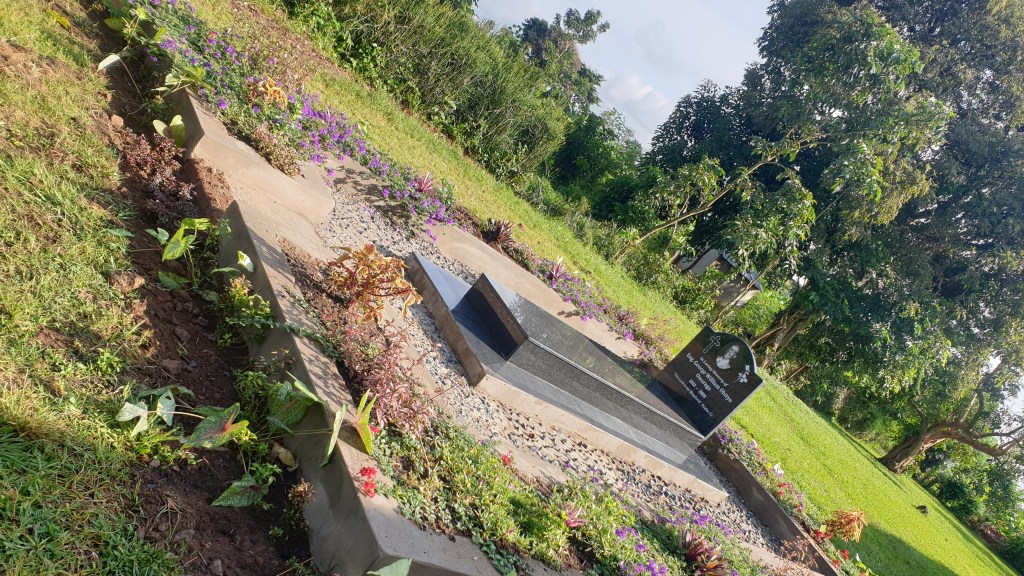
Featured photo, resting place of my late papa, in accordance to his wishes.




 Humanist
Let’s Chat…