
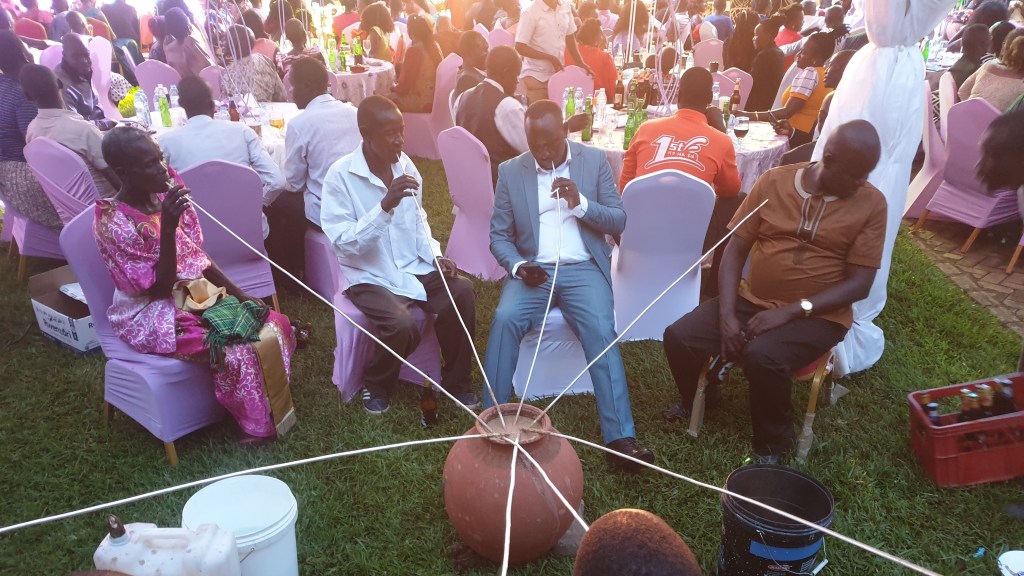
Today is the first day of the month of Osuban, as we, Iteso, the fifth largest first nation of Uganda, named November. In our Iteso agriculture-based seasons, Osuba is the last of four months in “The season of Plenty.” The other three months in the season of plenty are August, September and October.
Plenty that is, when her granaries are laden with simsim (sesame), groundnuts, millet and other dried food, and she has loads of cassava in-field with which to feed her family. Traditionally, among the Iteso, womenfolk were the food providers of the home and so were given full use-rights to ‘woman land’ on which to grow food.
All the harvest from ‘woman land’ belonged to the woman who was allocated use rights to it. She had granaries in which she stored her harvest and she had full control of how such food in storage in her granaries was utilised.
Plenty that is, when his cattle economy is booming – his kraal has a respectable number of animals and which enable him to provide his family with fresh milk, meat and other products. Traditionally, among Iteso, the role of acquisition and caring for cattle was of the man.
Being the last in the season of plenty, it is no wonder that Osuban was traditionally the month of celebrations or the month of ceremonies and rites:
- I see and hear my ancestors in times gone by making music with their percussion instruments – sansa (akongo), drums of varied make and sizes (atenus, ideteta, etida, emidiri), gourd-based rattles and pellet bells; with their wind instruments – trumpets of varied make and sizes (asukusuk, arupepe, aluut, esosi, alamaru, ebilo) and pan-pipes; and with their string instruments – ground-bow (aunene), arched harp (adeudeu) and tube-fiddle (adigidi).
- Their voices accompanied by musical instruments I hear them sing: “Tikir, tikir da, eleli; imanymany acoman, eleli, papa ka Onyangaese eleli. (Gallop, gallop, he is happy; he folds his apron happily, the father of Onyangaese is happy.)” I hear them sing: “Yosopina, inyoin ibore ikwanginia ijo? Arai ekolo? (Josephine, why have you turned pale? Is it jealousy?)” I hear them sing: “Arai ki giro angor ko gwel egaali ko keriana. (If the ladies do not like you, buy a bicycle and go riding).
- Moved by their music, I see them dance the ajosi, ekuma, ikacui, etida, and edonga dances.
My ancestors celebrated everyday things as well as significant moments. They held planting ceremonies, such as aitangar – blessing of the hoe by throwing grain over it on the altar (abila) followed by a beer party. With food, drink and music they celebrated the birth of a child, marriage, death, and others.
Celebrating and celebrations enabled my ancestors to heal, to maintain closeness, to nurture humanity and to harness social capital for the community greater good. That status quo held true through the 1960s, but perhaps less or no longer in this our 21st Century.
A major reason why our Iteso season of plenty no longer holds true is the impact of climate change and variability on agriculture production. These days, there are hardly any families in Teso with granaries – there is a declining presence of granaries in Teso. And a significant number of households of Iteso are chronically food poor.
They are barely surviving on one or two meals a day; food moreover that is not necessarily nutritiously balanced. Thousands are undernourished and are mal-nourished in Teso.
But still, I do have a lot to celebrate during Osuban. Today, 1st November 2023, is the third anniversary since my late papa, Ejakait Engineer George Willam Obityo Owaraga, the Chief of the Ekaribwok Isekelio Clan and King George of Entebbe, rested.
It has dawned on me that I continue to heal and that for the first time since he rested, I will not shed anniversary tears. I am transitioning to marking the anniversary of when papa rested with celebration, hence this celebratory post focused on Iteso culture, the culture of my people.
- I wonder, which Iteso musician should I partner with in order to write lyrics of songs celebrating papa?
- I wonder, what appropriate lyrics would they be?
- I wonder, which of the Iteso musical instruments would be the most appropriate to feature in papa’s song?
- I wonder, should it be a song accompanied by instruments and is ideal for dancing?
- I wonder, would a song about papa last for generations to come?
In the meantime, papa, it took your death for me to fully appreciate and to realize the hugeness of how good you were to me. You and mum named me Norah a name associated with strength, honour, dignity, respectability and majestic presence; and you nurtured me to embody my name.
Papa, you named me Alinga, the name of your mother and with the name came such cultural location, identity and power; the central pillar of my strength and courage as I continue to journey on this earth.
 The two chairs on the side were the favorite of my late papa. The photos from left to right: Owaraga II with his wife; papa with his grandson Owaraga III, papa and Jim Reeves’ record “songs to warm the heart”, among papa’s surviving collection that I treasure.
Papa, I am comforted, as well, that your name lives on through your son, Emmanuel George Owaraga II, whom you named after you; and through his son, your grandson, Gabriel Owaraga III, whom you also named after you. And yes, your daughter in-love, the wife of Owaraga II, is still honouring your request to her.
Thank you, eyalama papa, I celebrate!
Featured photo @ a modern wedding ceremony of Iteso in which ajon (Iteso fermented beer made of millet) was consumed as part of the celebrations held in the city.
Descriptions of Iteso culture I have borrowed significantly from the book “The Iteso”, by J. C. D. Lawrance.




 Humanist
Leave a reply to Traditionally the Iteso Calendar had three seasons – nowaraga.com Cancel reply