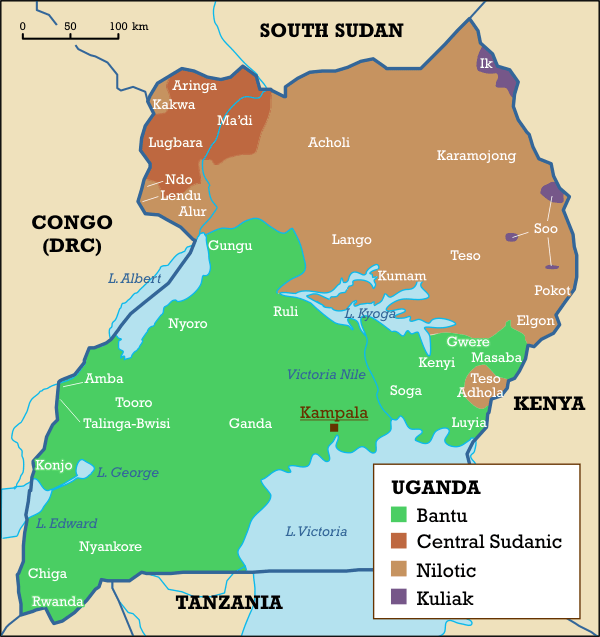
The complete list of Uganda’s Indigenous communities as at 1st February, 1926 as published in the Constitution of the Republic of Uganda (article 10 a); and population size as of 2024 as published by the Uganda Bureau of Statistics:

  1. Acholi – 1,941,913
  2. Aliba – 32,404
  3. Alur – 1,152,858
  4. Aringa – 872,714
  5. Baamba – 60,190
  6. Babukusu – 35,914
  7. Babwisi – 124,708
  8. Bafumbira – 949,860
  9. Baganda – 7,037,404
  10. Bagisu – 2,096,149
  11. Bagungu – 122,995
  12. Bagwe – 102,481
  13. Bagwere – 876,412
  14. Bahehe – 5,832
  15. Bahororo – 149.146
  16. Bakenyi – 101,395
  17. Bakiga – 2,947,837
  18. Bakonzo – 1,104,462
  19. Banyabindi – 11,947
  20. Banyabutumbi – 8,484
  21. Banyakore – 4,200,782
  22. Banyara – 47,438
  23. Banyaruguru – 53,027
  24. Banyarwanda – 629,672
  25. Banyole – 633,390
  26. Banyooro – 1,230,384
  27. Baruli – 207,464
  28. Barundi – 65,964
  29. Basamia – 543,661
  30. Basoga – 3,703,535
  31. Basongora – 13,837
  32. Batagwenda – 60,296
  33. Batoro – 1,005,433
  34. Batuku – 46,412
  35. Batwa – 3,857
  36. Chope – 26,029
  37. Dodoth – 235,196
  38. Ethur – 112,952
  39. Gimara – 14,367
  40. Ik (Teuso) – 15,241
  41. Iteso – 3,146,079
  42. Jie – 182,230
  43. Jonam – 112,011
  44. Jopadhola – 569,718
  45. Kakwa – 261,748
  46. Karimojong – 587,784
  47. Kebu (Okebu) – 51,672
  48. Kuku – 102,007
  49. Kumam – 350,040
  50. Langi – 2,703,277
  51. Lendu – 18,801
  52. Lugbara – 1,218,121
  53. Madi – 385,629
  54. Mening – 2,271
  55. Mvuba – 382
  56. Napore – 24,004
  57. Ngikutio – 5,990
  58. Nubi – 29,762
  59. Nyangia – 24,978
  60. Pokot – 203,186
  61. Reli – 9,596
  62. Sabiny – 357,347
  63. Shana – 7,209
  64. So (Tepeth) – 19,286
  65. Vanoma – 680

Source Wikipedia

15 responses to “Uganda’s Indigenous Communities as at 1st February 1926 and 2024 population”

  1. Good to share the indigenous groups in Uganda but for me I can only remember less than 20 tribes.

    Liked by 1 person

  2. […] Tata is grandma in Ateso – language of the Iteso people, the fifth largest first nation of Uganda. […]

    Like

  3. […] Constitution of the Republic of Uganda recognises 65 first nations of Uganda, which it refers to as “tribes”; and each of them have a language. However, none of our […]

    Like

  4. […] Sarah Opendi, the Marriage Bill 2022, one may be persuaded to believe that customary laws of the first nations of Uganda are devoid of logic on matters […]

    Like

  5. […] I was recently privileged to be part of a conversation during which the aspect of one’s identity was discussed, among other issues. It was fascinating for me how some of my fellow country folk cautioned the rest of us not to identify as among members of our respective 56 plus first nations of Uganda. […]

    Like

  6. […] Time is now to break the monopoly of English as Uganda’s only official language. Uganda is the most ethnically diverse nation in the world. […]

    Like

  7. […] the official language of Uganda. And yet, Luganda, the language of Buganda Kingdom, the largest of the 65 first nations of Uganda, is widely spoken in Uganda and in its neighboring […]

    Like

  8. […] cultures for all the 50 plus first nations of Uganda are essentially oral. Our history is captured and archived in music – songs, plays, drama, […]

    Like

  9. […] Find the detailed list of all the first nations of Uganda and their population size in “Uganda’s Indigenous Communities as at February 1926 and 2024 population.” […]

    Like

  10. […] culturally dislocated from the the culture of their own Ugandan first nation, but are not fully accepted and assimilated to the European culture will tend to gravitate to a […]

    Like

  11. […] Uganda’s indigenous communities as at 1st February 1926 and 2024 population […]

    Like

  12. […] that the princes hold only their family name, Nadiope, as rooted in the culture of the third largest first nation of Uganda, Busoga Kingdom. Their other two names, their individual identifier – Arnold and Eli; and William and Ethan […]

    Like

  13. […] more on Uganda’s indigenous communities CLICK HERE and read: “Uganda’s Indigenous Communities as at 1st February 1926 and 2024 Population […]

    Like

  14. […] To familiarize with the diverse first nations of Uganda we recommend two blog posts: “First Nations of Uganda” and “Uganda’s Indigenous Communities as at 1st February 1926 and 2024 Population.” […]

    Like

  15. […] CLICK HERE to read more about the sizes of Uganda’s indigenous communities […]

    Like

Let’s Chat…

RECOMMENDED

Discover more from Humanist

Subscribe now to keep reading and get access to the full archive.

Continue reading