It never ceases to amaze me how Uganda’s education system produces Ugandans whose minds are so colonized.
Specifically, against acknowledging and celebrating traditional knowledge systems of the peoples of the first nations of Uganda – the Iteso, the Buganda, the Banyakigezi, all indigenous communities of Uganda.
It is mind blowing how factoids permeate presentations on Uganda by Ugandans.
A factoid is an assumption or speculation that is reported and repeated so often that it becomes accepted as fact (source Google). An example of a real factoid is this assertion made during an official government presentation:
A lot of the information you see presented there (his power point presentation) is backed by research. So it is not easy to dispute what was proven by research.
Yes, this declaration was made by a Government of Uganda official.
One who described himself as being a Sustainable Land Management Specialist and a Soil Scientist working with the Ministry of Agriculture Animal Industry and Fisheries (MAAIF).
The specialist soil scientist delivered his eye-popping, jaw-dropping assertion about the infallibility of his presentation right after significantly knowledgeable persons had spoken of the same issue. Including me, I might add.
We had each authoritatively punched holes in his presentation, during a discussion session that followed his presentation.
Nevertheless, the specialist soil scientist’s assertion of the infallibility of his presentation also manifested his tendency to possesses Trump-like, patronizing, condescending, inferiority complex characteristics.
Arrogantly manifesting as a misguided superiority complex.
Sadly, this is not uncommon among Ugandan’s who have undergone Uganda’s bastardised version of the colonial global-western education system, the English one to be exact.
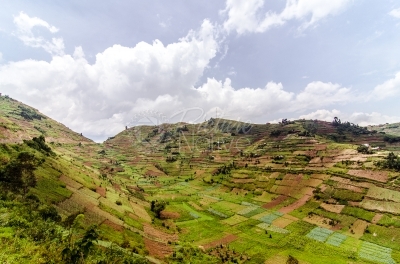
Take for instance, one of the images the specialist social scientist used in his power point presentation was of terracing or terraces in South-Western Uganda.
The tone of his presentation made it seem like terracing was among the ‘new’ and ‘modern’ ideas that should be promoted among sustainable land management practices that Ugandans should be taught, learn and practice.
Another officer of MAAIF repeated that particular factoid, asserting:
In Kigezi, in the past, the colonialists established terraces, the terraces have now collapsed and I think we are not making any efforts to reinstate them.
Well, expectedly, the specialist soil scientist did not use his response-time to correct this second false assertion, a factoid.
In which case, I can only assume that he actually believed it to be true that the practice of terracing in Kigezi is of exogenous knowledge systems, originating from outside of Uganda.
Mmmmm.
This passing of huge factoids as empirical findings popped my eyes and dropped my jaw. I went wide eyed and uncontrollable exclaimed aaaah! Lucky for me, we were in the confines of a top notch hotel in the city, where flies are extinct.
Otherwise, my dropped jaw rendered my mouth open for a significant time. It would have allowed a swarm of those blue flies associated with garbage to have easily flown in.
Once I recovered, my jaw no longer dropped and my mouth shut as it normally should be, I thought of sending a Facebook message to Dr. Muniini K Mulera. He, after all, is the Chairman of the Banyakigezi in the Diaspora.
The message would have been to request him to verify the origin of the practice of terracing in Kigezi.
But, then again, search engines, such as Google, have surely become every researcher’s first port of call for finding out fast.
So, I went to Google and typed the key words “terracing, Kigezi, history” and in seconds, loads of links to sources of resources resulted. I clicked on the link I felt most viable and my first choice led me to Richard Miiro’s paper titled:
“Factors enhancing terrace use in the highlands of Kabale District, Uganda (Miiro 2001).” Miiro, is a scholar at the Department of Agricultural Extension/Education of the Faculty of Agriculture of Makerere University Kampala.
Miiro’s paper is short – only six pages including references, and it is a free pdf download. Indeed, it turned out extremely viable. Right therein, the first sentences of the Introduction reads:
The practice of soil conservation using terraces dates back to the pre-colonial era. Terraces were part of the indigenous and cultural ways of adapting agriculture to the steep nature of land in South-Western Uganda… Between 1920-1935 before any colonial administrative effort was made towards soil conservation, terrace cultivation existed; crops were grown in strips across the slopes with intervening strips of un-cleared land.
It has always been my understanding that among the indigenous agricultural knowledge systems of the first nations of Uganda is the practice of terracing.
Factoids litter presentations made during major decision making forums, internationally and nationally.
Forums whose resolutions have direct consequence of influencing content and form of policies that have direct impact on the lives of Ugandans.
The case discussed herein is not unusual.
What will it take for Ugandans to decolonise our minds?
What will it take for Ugandans to appreciate that among our greatest wealth is our inheritance of that which our ancestors bequeathed us in form of their pre-colonial traditions and practices – our indigenous knowledge systems?
The time to re-think our education system is overdue.
Works Cited Miiro, Richard. “Factors enhancing terrace use in the highlands of Kabale District, Uganda.” Sustaining the global farm – selected papers from the 10th International Soil Conservation Organisation meeting held May 24-29, 1999 at Purdue University and the USDA-ARS National Soil Erosion Research Laboratory. 2001. 356-361.
Photo Credit: Picturenative.com







Let’s Chat…