The importance of well researched and well written books can not be overestimated. One such book is “The Iteso”, by J.C.D. Lawrance for Eria Paulo Engulu, M.B.E., Chief Judge of Teso in the 1950s and his people.

Since I got to learn of and to acquire “The Iteso” (photocopy of the full book), I feel blessed in terms of having a valid and a strong connection with my ancestry and my roots from whence I am descended.
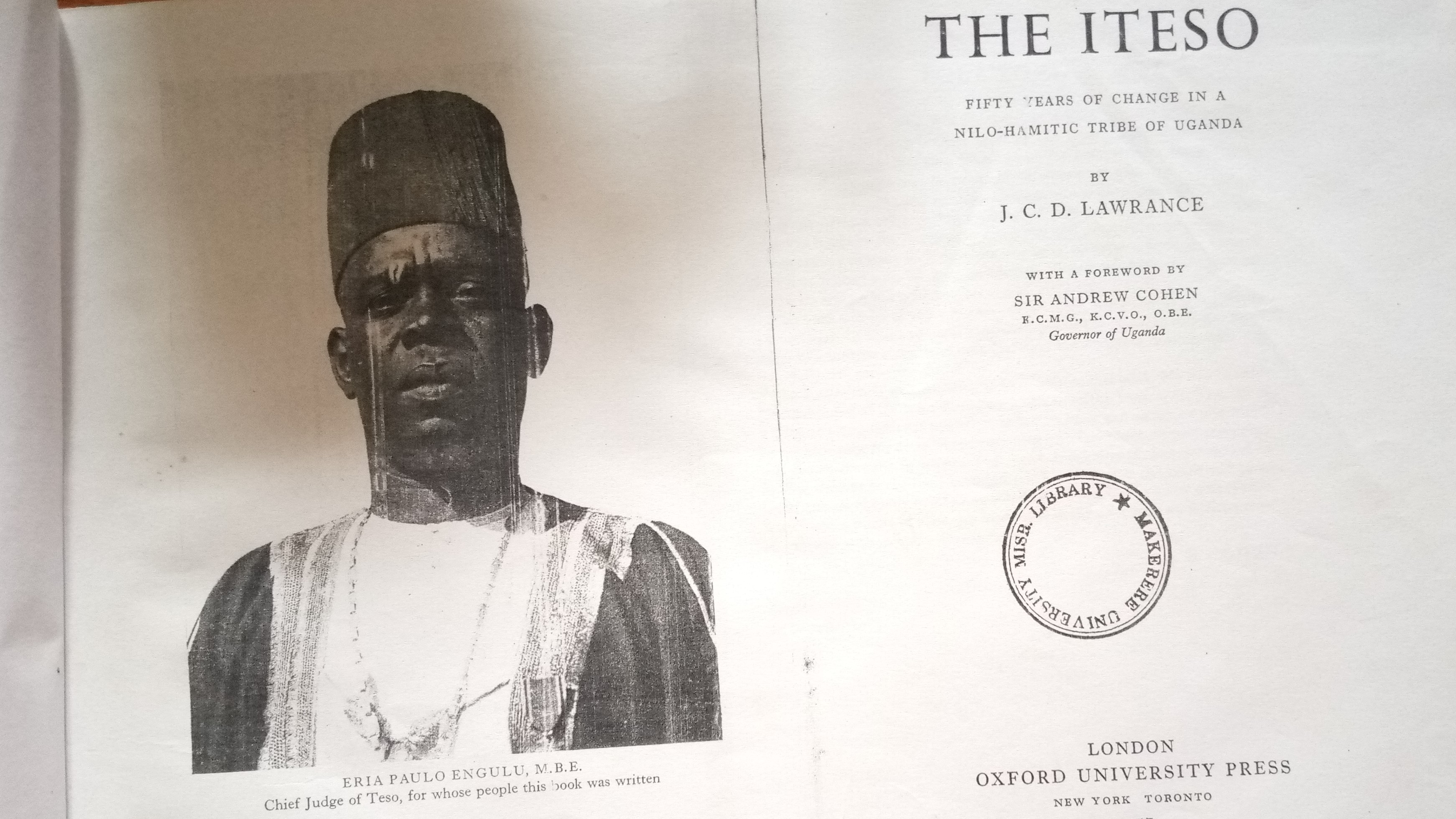
The book is a great reference point for me in all aspects. For example, in the 1950s when the book was written, the Iteso were the second largest first nation of Uganda. We are now the fifth largest. Whatever happened?

Also, in the 1950s, Iteso, my people, were described as “a wealthy and progressive community.” We are now arguable among the least wealthy, economically and materially; and perhaps, the least progressive community, judging by the manner in which we are allowing the ethnocide of our culture. Whatever happened?

“The Iteso”, by the way, articulates changes among Iteso and in Teso over a 50-year period. Here is a review of the book that I largely agree with.

When I am called upon to advise and to contribute to how those seeking to practice our culture, it is from this book that I seek wisdom. One such instance is when I am asked or would like to know the appropriate Teso practice for welcoming a new born child into a family and into a clan, including naming ceremonies.

Yes, I recently became ija (aunt) again and needed to check the appropriate gifts to give. I now know and I am going to gift accordingly. Unfortunately, not all of the traditional gifts will I be able to gift, in which case I will have to improvise and this itself will be fun!

Emuria koliai!

23 responses to “Book Review: “The Iteso””

  1. Eyalama noi

    Liked by 1 person

  2. […] You can further educate on this by reading the book: “The Iteso”. […]

    Like

  3. This is inspirational

    Liked by 1 person

  4. […] which I belong, the Iteso First Nation. And so, without much ado, I consulted my favourite book: “The Iteso,” by J.C.D. Lawrance, which even though written from a colonisers perspective, provides a good reference from whence to […]

    Like

  5. […] Iteso homestead as documented on the book: “Iteso” by J.C.D. Lawrence […]

    Like

  6. […] J.C.D. Lawrance in his book: “Iteso” […]

    Like

  7. […] It was unusual for women to cut their hair except at ceremonies connected with childbirth.” J.C.D. Lawrance in his book: “Iteso” No wonder, therefore, history has it, that in the Atlantic Slave Trade, when millions of Africans […]

    Like

  8. […] J. C. D. Lawrance in his book “The Iteso” […]

    Like

  9. […] his book “The Iteso”, J.C.D. Lawrence, for example, devotes a sub-section titled: “Kakungulu’s Empire” […]

    Like

  10. […] “This ceremony is known as the smearing ceremony (ainyonyo) and may take place at the time when the new bride is brought by her relatives to her husband’s village on the marriage day.” J.C.D. Lawrence in his book: “The Iteso” […]

    Like

  11. […] J. C. D. Lawrence in his book: “The Iteso – Fifty years of change in a Nilo-Hamitic Trib… […]

    Like

  12. […] Within Iteso customary law, a distinction is made between bride-price and bridal gifts. In Iteso customary marriage, apart from bride-price, certain presents are customarily given by the bridegroom (source: J.C.D. Lawrence, “The Iteso”): […]

    Like

  13. […] Descriptions of Iteso culture I have borrowed significantly from the book “The Iteso”, by J. C. D. Lawrance. […]

    Like

  14. […] of Agriculture Animal Industries and Fisheries, speaking in her capacity as a daughter of our Iteso nation, Atesot, advocating for the celebration and preservation of Iteso food […]

    Like

  15. […] The Iteso – Fifty Years of Change in A Nilo-Hamitic Tribe of Uganda, by J. C. D, Lawrance […]

    Like

  16. […] J. C. D. Lawrence in “The Iteso – Fifty years of change in a nilo-hamitic tribe of Ugabd… […]

    Like

  17. […] “The Iteso – Fifty years of change in a nilo-hamitic tribe of Uganda,” authored in the 1950s by J.C.D. Lawrence, is my favourite book on and about Iteso, before my time and that is based on empirical evidence. Tears & Triumph, set from the 1960s to date, nicely complements “The Iteso” as a valuable empirical documentation of Iteso culture for posterity. […]

    Like

  18. […] Aspects of Iteso marriage traditions sadly no longer known by our generation of Iteso, include, for example, “marriage preliminaries”, as described by J.C.D. Lawrence in his book, “The Iteso”: […]

    Like

  19. […] marriage was taken seriously as that which binds together Iteso of different clans. In his book, The Iteso, pages 93 -98, J. C. D. Lawrence describes in detail Iteso marriage rituals, traditions and ceremonies that are in two major stages […]

    Like

  20. […] Aspects of Iteso marriage traditions sadly no longer known by our generation of Iteso, include, for example, “marriage preliminaries”, as described by J.C.D. Lawrence in his book, “The Iteso”: […]

    Like

  21. […] “In olden days (in Teso) the dead were buried either in the cattle kraal or in the house in whch they lived, the house continuing to be occupied for some time after the interment. When huts containing graves were finally abandoned, they were never pulled down or destroyed, but left to decay.” Source: “The Iteso” by J.C.D. Lawrence […]

    Like

  22. […] learn more about Iteso marriage ceremonies, there is an empirical description of them in the book: “The Iteso – Fifty Years of Change in a Nilo-Hamitic Tribe of Uganda,” by J. C. D. Lawrence. I wish it were still feasible to do all of them. It is the kind of marriage I […]

    Like

Leave a reply to African Culture, Blood-Money & Death Penalty – nowaraga.com Cancel reply

RECOMMENDED

Discover more from Humanist

Subscribe now to keep reading and get access to the full archive.

Continue reading